
By Florian Bielser
In Senegal’s Sine Saloum region, villages near the banks of river valleys suffer extensive damage every year from run-off. The problem has grown after decades of deforestation upstream of the villages and clearing of riverbanks, which have destabilised the physical environment (farmland and ecosystems), the biophysical environment (fauna, birdlife, flora) and aspects of people’s lives and mobility (housing, roads and so on).
Today, gullies and landslides threaten roads, farm plots and buildings. If nothing is done, areas affected by this network of gullies are often moved or abandoned altogether. The limited measures taken by local people and authorities to break the vicious circle have not worked, because they are too localised, often unsuitable and not based on an understanding of how water erosion works. Climate change adds to this vulnerability by making extremes more severe (drought, variable and intense rainy periods), accelerating the impoverishment of biodiversity, soils and ecosystems, and eventually driving rural exodus.
As part of the project “Sunu Ëulëuk, Sunu Ecosystème – Supporting the transition to agroecological territories”, IRHA and our local partners, the Senegalese rainwater association ASGEP and Caritas Kaolack, are spreading new ways of thinking about and managing the land, and in particular the heavy run-off of the rainy season. In Ndayène Poste, a small village 10 kilometres north of the Gambian border, a network of anti-erosion structures is being built with strong community involvement.
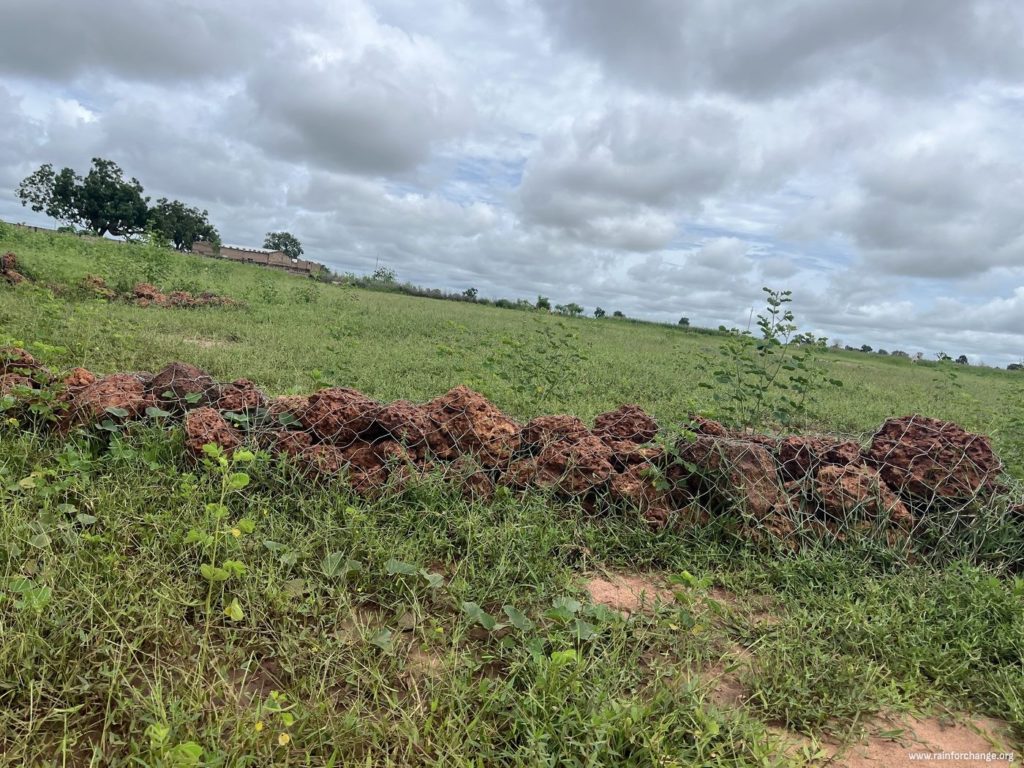
Two levels of intervention are used. The first is preventive: vegetated stone lines are placed as a “shield” upstream of the village, to slow run-off and reduce its power to erode and carry sediment. At the same time, corrective structures – gabions, stones wrapped in wire mesh – are built in the gullies themselves to slow erosion and help the incisions already formed to fill in.
During my field trip in May, I had the pleasure of taking part in the start of this rehabilitation work. More than 50 community members turned out, and nine donkey carts were made available. This enthusiasm, from people of all ages, was only possible because a series of meetings had been held with the villagers beforehand to explain the causes of the gullies and possible solutions. These meetings are an opportunity for rich exchanges with communities that want to make their land resilient and sustainable, and they help identify the key people to rely on when carrying out the work.
After three days, 70 metres of gabions and around 60 metres of stone lines had been installed. A great deal of work remains, especially on the anti-erosion “shield” upstream of the village. But the villagers have taken ownership of these techniques and decided to continue the work until the rainy season. This community mobilisation is extremely encouraging and promises a fruitful partnership between the project partners and the people of the region.
Read more on the project page: Transition to Agroecological Ecosystems.
First published on the former IRHA website on 15 June 2023.