
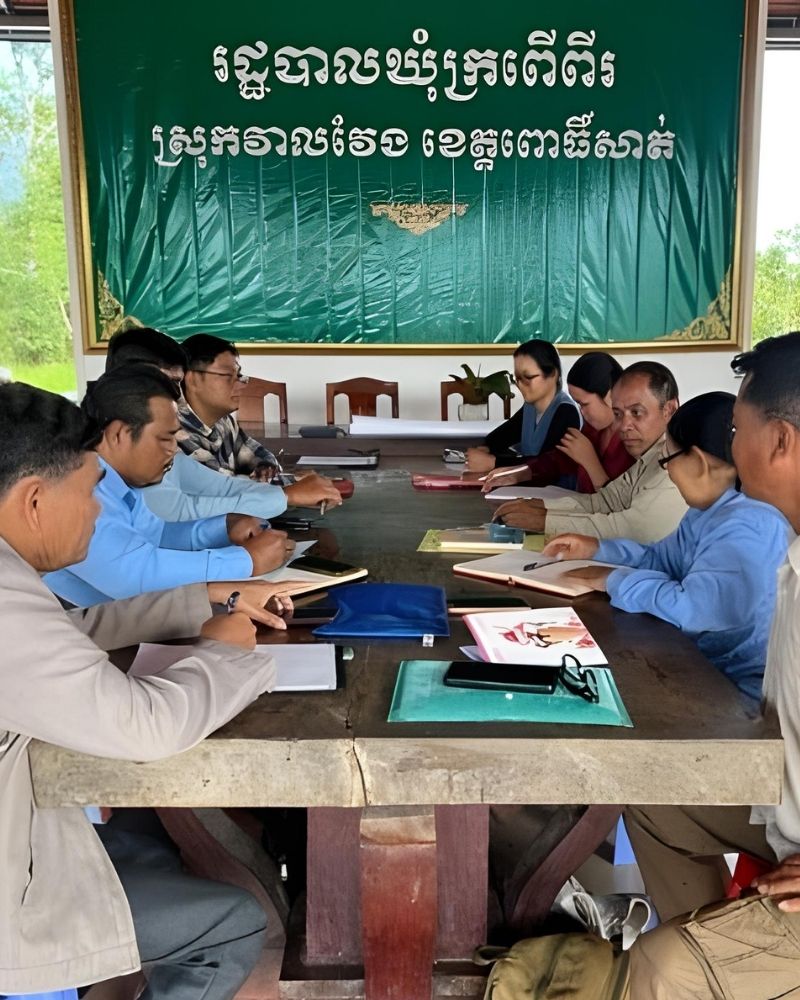
With Rainwater Cambodia, rural communities and local authorities in Kampong Thom Province are working to secure safe water, sanitation and hygiene through rainwater harvesting.
The challenge
In Cambodia, climate-related disasters are becoming more frequent and are making water stress worse. Droughts deplete water resources and floods pollute them. As these crises intensify, water scarcity harms health and hygiene and deepens inequalities. Children and vulnerable people are hit hardest. Schools, health centres and households all need a safe and reliable water supply.
A three-year project in Sala Visai
This is the starting point of Rain Communities Cambodia, a three-year project (2025–2028) in Sala Visai, Kampong Thom Province. It is led by Rainwater Cambodia, a member of the IRHA Alliance, with funding from the Fédération genevoise de coopération (FGC). With Sri Lanka, Cambodia is one of the two countries where IRHA launched new Rain Communities in 2025, building on its experience in Nepal and Senegal.
A Rain Community is a landscape approach to resilience: it manages rainwater as one connected system that links water, soil, vegetation and livelihoods.
What the project plans
- 27 public rainwater systems of 30 m³ for schools, health centres and public supply
- 3 large-scale drinking-water networks
- 250 household rainwater tanks of 8 m³
- 200 sanitation facilities
- 105 infiltration and aquifer recharge systems
- more than 30 training courses
- more than 20,000 people reached, 40% of them women
Beyond construction
The project looks beyond tanks and pipes. It starts by building up knowledge of water management in the area and developing an action plan with local authorities and communities. Local authorities are expected to lead efforts to improve access to drinking water. Local business owners will be supported to offer rainwater harvesting systems and services, so that the know-how stays in the area after the project ends. Training and awareness-raising among authorities and communities complete the approach.
Together, these steps aim to secure water, in quantity and quality, for schools, health centres and households, and to leave communities with stronger knowledge and technical skills.
Read more on the project page: Rain Communities Cambodia, and on our Rain Communities page.
Added to our news archive in November 2026.