
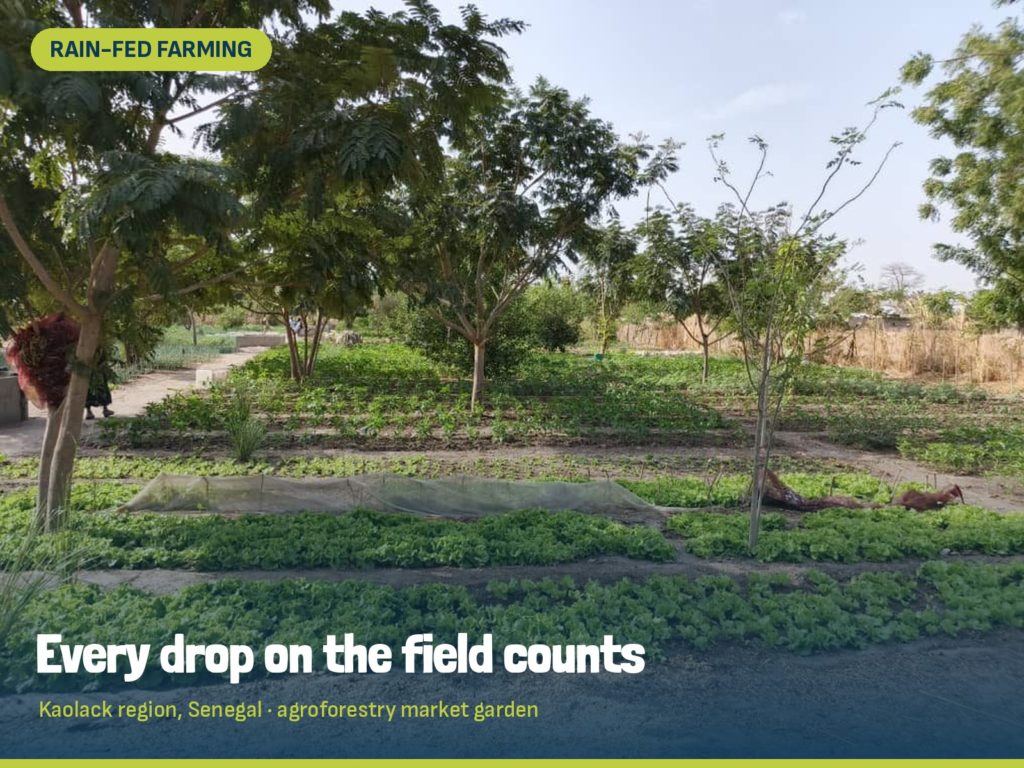
Most farming on Earth depends on rain alone. According to the Food and Agriculture Organization of the United Nations (FAO), rain-fed agriculture represents more than 80% of land under cultivation and 60% of global crop production, and about 11% of the world’s rain-fed cropland – 128 million hectares – faces frequent drought (FAO, The State of Food and Agriculture 2020). When rains become shorter, later or more violent, the farmers who rely on them are the first to suffer.
Keeping the rain where it falls
On degraded, compacted soils, heavy rain runs off, carrying the most fertile topsoil with it, and the dry season starts even earlier for the crops. IRHA’s Rain-fed Agriculture and Food Sovereignty programme helps farming communities reverse this, using agroecological principles and planning at landscape level. The core methods are rain-fed garden systems such as half-moons and deep beds, terracing and bunds that hold water, soil regeneration through mulching and composting, and farmer training in agroecology, water-smart farming and local seed systems.
Deep beds show how simple these methods can be. Farmers break the hard, compacted layer under the surface with a pickaxe so that roots, water and air can go deep into the soil. Ridges are then built along the contour, each with a trench that collects run-off after heavy rain. The beds keep the soil moist and allow vegetables to be grown all year round (IRHA fact sheet 4).
Trees are part of the answer. Agroforestry plots combine trees, crops and sometimes livestock on the same land. Leaves and crop residues left on the ground slow run-off and protect the soil from drying out; roots anchor the soil and help water infiltrate; shade lowers soil temperature and evaporation (IRHA technical fact sheets). Hedges and groves planted along the contours – the bocage – structure the landscape and help it retain and infiltrate rainwater.
Food security or food sovereignty?
As Marine Protte-Rieg of APAF Senegal put it in an interview on our blog in 2020, food security is about people being fed with enough food, while food sovereignty also asks who decides how food is grown. It links the health of ecosystems with public health and affirms people’s right to choose how they farm. That is why IRHA’s projects work with farmers’ groups, women’s groups and local partners, rather than delivering ready-made solutions.
What it looks like in the field
In Senegal, Women of the Land and Rain works with ASGEP, the Senegalese rainwater association. In its first year, 2025, seven women’s groups were trained in agroforestry and rainwater management, and 863 kg of produce was sold during the rainy season (Annual Report 2025). In Nepal, Rain Communities combine pond restoration, reforestation, agroecological training and a community seed bank that keeps reliable local varieties in use.
The common thread is the triptych of water, soil and trees: catch the rain, protect the soil, plant the trees that hold both. When farmers can rely on the water in their own soil, they depend less on irregular rainfall and on costly inputs – and they keep more control over what they grow and eat.
Read more about Women of the Land and Rain and our other projects.