
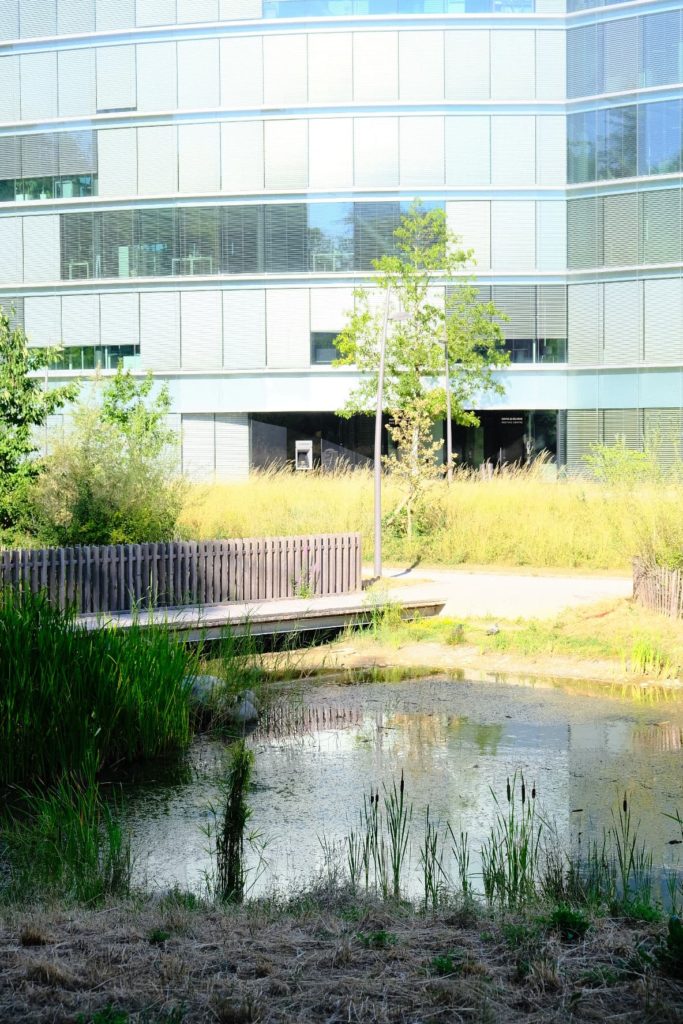
A sponge city absorbs, cleans and uses its rainwater through natural landscapes instead of piping it away; IRHA’s Rain in the City programme and its Geneva project PluiË follow the same idea.
In most cities, rain is treated as waste. It falls on roofs, roads and car parks, rushes into drains and is piped away as fast as possible. When storms become heavier, the pipes overflow and streets flood; when droughts come, the water that could have refilled the soil and the trees is long gone.
The sponge city idea
The “sponge city” concept, pioneered by the Chinese landscape architect Kongjian Yu, turns this logic around. A sponge city is designed to absorb, clean and use rainwater through natural landscapes: it catches the rain, slows it down, lets it soak into the ground and stores it for dry periods. As we wrote on this blog in 2024, cities such as Zhenjiang, Xiamen and Shenzhen in China have shown how policy support can drive large-scale change, and the 34-hectare Qunli Stormwater Park in Harbin collects, cleans and stores stormwater while providing a green public space.
Making the city “transparent” to water
IRHA’s Rain in the City programme follows the same idea. Its aim is to make the city transparent to rainwater, so that rain can evaporate, be used by plants or infiltrate where it falls. In practice, that means (IRHA technical fact sheet 9):
- infiltrating gutter water on site through rain gardens, swales and infiltration wells;
- replacing concrete and asphalt with permeable surfaces such as porous paving, gravel or grassed paving;
- handling storm peaks with buffer volumes: swales, porous pavements, tree pits and green roofs;
- bringing back vegetation and urban water bodies to create cooler, more humid microclimates;
- disconnecting rainwater from sewers and reusing it where possible.
Behind these techniques is a change of mindset: moving away from a purely pipe-and-drainage approach, accepting rainwater in public and private spaces, and using it as a resource rather than as waste to be disposed of. Dense ground cover and gentle, open water paths slow the flow before it ever reaches a drain.
The benefits add up: less run-off and lower flood risk downstream, groundwater recharge, cooler streets during heatwaves and more space for biodiversity.
PluiË: changing how Geneva sees the rain
Like many places, Geneva now swings between droughts and intense rain. Changing how rainwater is managed starts with changing how people see it. Since 2023, IRHA’s PluiË project has invited people in Greater Geneva to see rain as a resource rather than a nuisance. Rain tags painted with a transparent, water-repellent product appear on pavements only when it rains. Rain walks show how rainwater is collected and feeds plants. Dances with Global Water Dances – Geneva, the mobile exhibition “Vis ma pluie”, clay-jar workshops in shared gardens and rain tales told in schools complete the programme. In 2025, PluiË ran four activities in schools and produced eight illustrated stories linking Geneva with Senegal and Nepal.
The next step is Boîte à Pluie (September 2026 – August 2029): a five-module learning kit and 20 trained facilitators, so that teachers and youth workers can bring rain into their own activities with 1,125 children.
Read more about PluiË and Boîte à Pluie.