
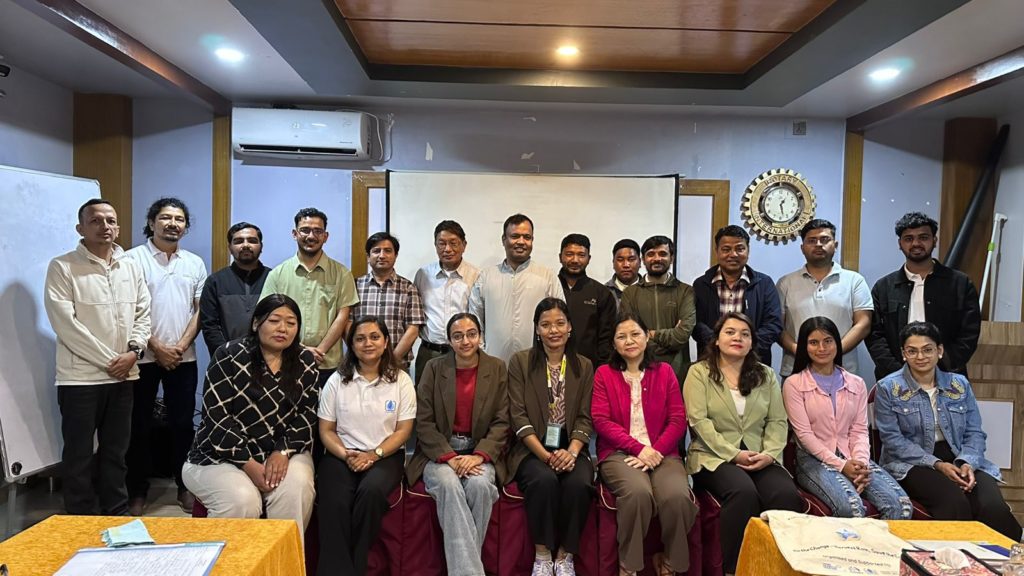
IRHA works through local partners: they lead the work on the ground, and IRHA supports them with technical advice, project management, monitoring and fundraising.
The International Rainwater Harvesting Alliance is a small Geneva-based NGO with a global reach. To date, IRHA’s programmes have reached 1,017,165 people (234,215 direct and 782,950 indirect beneficiaries, cumulative to 2025, Annual Report 2025). That is only possible because IRHA does not work alone: the work on the ground is led by local partners who know their communities, their landscapes and their languages.
An alliance, in name and in practice
IRHA brings together national rainwater associations and expert partners on five continents. In 2025, the Alliance had eleven members: ARCSA International (United States), ABCMAC (Brazil), AMSCALL (Mexico), ASGEP (Senegal), the Lanka Rain Water Harvesting Forum (Sri Lanka), the Madagascar Rainwater Harvesting Association, the Nepal Rainwater Harvesting Association, Rain for All (South Korea), the Rainwater Association of Somalia, the Rainwater Harvesting Association of Malawi and Rainwater Cambodia. Since the Membership Framework was adopted in December 2025, Alliance members have been invited to relevant IRHA meetings with a voting right; in June 2026, nine of the eleven took part in the General Assembly for the first time.
Who does what, and what each partner brings
In each project, a local partner leads the work. IRHA supports it with technical advice, project management, monitoring and fundraising, and shares the results internationally. Each partner brings strengths of its own:
- Kanchan Nepal (Pokhara region, Nepal), an IRHA partner since 2013: long roots in the region, pumpkin-shaped cisterns for remote mountain villages, and 3D participatory mapping, where pupils and families model their own landscape and plan together. With LI-BIRD and SVSI, it is building the Rain Community of Tobang, in Pokhara.
- Lanka Rain Water Harvesting Forum (Kurunegala District, Sri Lanka): technical depth and a regional network. A member of the IRHA Alliance, it hosts SARNET, the South Asian Rainwater Network, and now leads a Rain Community in the district where four schools became Blue Schools in 2025.
- Rainwater Cambodia (Kampong Thom Province, Cambodia): close links with local authorities and businesses. In Sala Visai, the Rain Community plans to support local entrepreneurs, so that rainwater skills and supplies stay in the area.
- ASGEP and Caritas Kaolack (Fatick and Kaolack regions, Senegal): women’s leadership and farmers’ knowledge of the land. ASGEP runs Femmes de Terre et de Pluie with women’s groups, combining agroforestry, rainwater and participatory theatre; Caritas Kaolack accompanies farming families on the move to agroecology. Both use half-moons and bunds that keep rain where crops need it.
- Caritas Kasese (western Uganda): local masons, women among them, trained to build affordable rainwater tanks.
Earlier phases also relied on Océanium Dakar, which restored mangroves with local communities, and on APAF Sénégal. In Geneva, PluiË is made with Global Water Dances – Geneva, Céramiques des Subsistances, Genève Cultive and La Libellule: our partners, and Rain Guardians too.
In line with its commitment to reduce environmental impact, IRHA coordinates most activities remotely, with targeted field missions to support implementation and dialogue. In 2025, missions took the team to Senegal, Sri Lanka, Uganda and Kenya, and IRHA took part in Pakistan’s national rainwater harvesting conference and supported Malawi’s.
Communities first
Projects start with the people who will live with the results. In a Rain Community, residents and local actors first build a shared picture of their area – often with 3D participatory maps – and agree on an action plan. In a Blue School, a committee of parents, authorities, teachers and pupils manages the facilities. Local masons are trained to build and repair tanks, so that the skills stay in the area.
Learning from each other
Knowledge travels in every direction. Calabash tank builders from Guinea-Bissau trained masons in Senegal; a Sri Lankan woman mason trained Kanchan Nepal’s masons to build pumpkin-shaped tanks; the PartageÖ project connects Geneva NGOs with rainwater specialists from the Global South through workshops, webinars and technical fact sheets.
Clear rules
An Ethical Charter, adopted in December 2025, sets the standards that staff, consultants, partners and Alliance members commit to: mutual respect, human rights, respect for communities and their customs, and a smaller carbon footprint. It will be part of the agreements IRHA signs with Alliance members. IRHA is grateful to the Fédération genevoise de coopération (FGC), whose long-standing support makes much of this work possible. Several IRHA projects also follow the FGC’s quality framework, based on sustainability, partnership, local ownership and rigorous monitoring and evaluation, and IRHA has held the ZEWO quality seal since 30 April 2026.
Meet the members on our Alliance page and read about our approach.
Stay in touch: follow our upcoming events and latest news.