
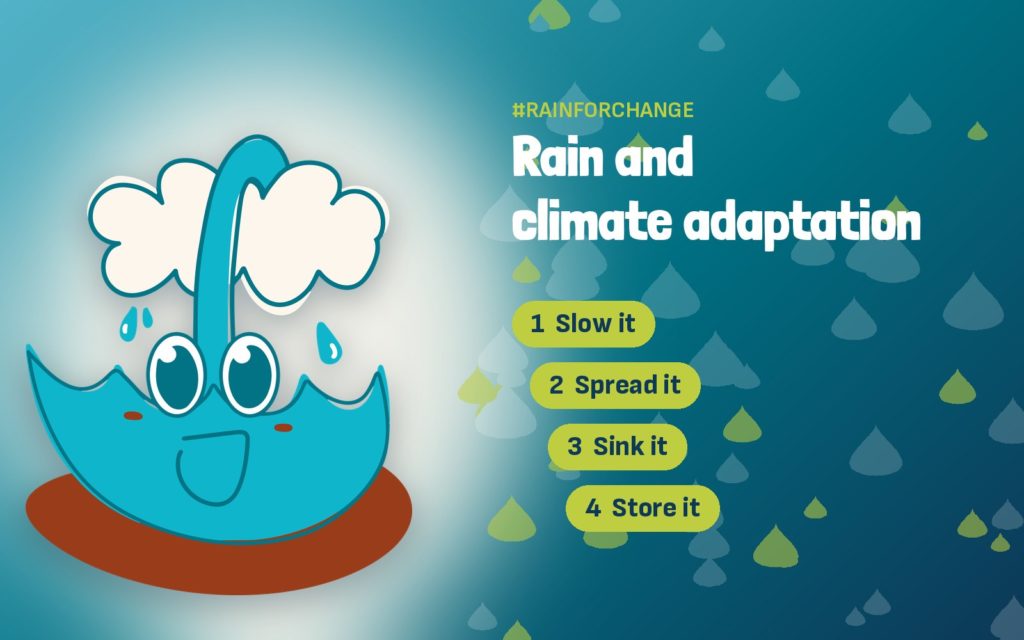
Rainwater helps communities adapt to climate change by keeping water in the landscape: slow it, spread it, sink it, store it.
Climate change is felt first through water. According to UNICEF, around 74% of natural disasters between 2001 and 2018 were water-related, including droughts and floods (UNICEF). At the same time, 2.1 billion people still lacked safely managed drinking water in 2024 (WHO/UNICEF JMP, 2025). For many of them, the most reliable water source is the one that falls on their own roof and fields.
Too much and too little
Floods and droughts are two sides of the same problem. On bare, sealed or degraded land, heavy rain runs off fast: it erodes soil, damages homes and roads, and is gone before the dry season starts. Groundwater is not recharged, springs and wells dry up earlier, and the next drought hits harder. Managing rainwater breaks this cycle by keeping water in the landscape for longer.
Children are among the most exposed. UNICEF estimates that 436 million children live in areas of high or extremely high water vulnerability, and that by 2040 almost one in four children will live in areas of extremely high water stress. In coastal areas, rising seas are also making fresh water salty (UNICEF).
Four simple verbs
- Slow it: stone bunds, terraces, hedges and gabions reduce the speed of run-off and the damage it causes.
- Spread it: half-moons, contour trenches and mulch spread water across the field instead of letting it rush downhill.
- Sink it: infiltration ponds, recharge wells and permeable surfaces in towns let water soak in and refill aquifers.
- Store it: household and school tanks, and retention ponds such as Senegal’s boulis or Nepal’s pokharis, keep water available for months after the rains.
Ecosystem-based adaptation
IRHA’s Strategy 2026–2030 places rainwater harvesting at the heart of ecosystem-based adaptation. It connects water, soil and trees: water is the basis of life, soil anchors fertility and food production, and trees bring shade, biodiversity and long-term resilience. In practice, this is what a Rain Community does. In Kurunegala District, Sri Lanka, where recurring droughts and floods have weakened communities’ ability to manage their water, the Rain Communities project plans 170 household and 30 public rainwater tanks, 105 infiltration and groundwater recharge systems and 20 nurseries for trees and plants, for more than 20,000 people.
People at the centre
Adaptation is also social. In many regions where IRHA works, women and children carry 30 to 50 litres of water a day for their households. Water close to home frees time for school and income, and gives women a stronger voice in how water is managed. As IRHA Committee member Sálvano Briceño, former director of the UN Office for Disaster Risk Reduction, told us in 2019, harvesting rain also makes people more aware of how their water supply varies – an anticipatory attitude that helps them prepare for recurring droughts.
From local to global
Rainwater harvesting is cheap, decentralised and quick to build, and it works in villages and cities alike. That is why IRHA and its Alliance members advocate for it to be part of national adaptation strategies and water policies, from the Kathmandu Declaration on rainwater harvesting in 2024 to the 2026 UN Water Conference.
Read more about Rain Communities and our approach.