
On 10 November 2026, IRHA co-founder Margarita Pacheco spoke about flying rivers and rainwater at an online panel of Latin America Week 2026, organised by the University of St. Gallen in Switzerland.
Some of the rain that falls on Bogotá, high in the Colombian Andes, began its journey over the Amazon. That was the thread of the talk given by Margarita Pacheco, architect, co-founder of IRHA and member of its Committee, at “Reconfigurando fronteras” (Reshaping Borders), an online panel of Latin America Week 2026. The week runs from 9 to 13 November and is organised by the Institute of Management in Latin America at the University of St. Gallen, the Leading House for the region. The panel was moderated by Leyder Elena Lozano and Pedro Romero, honorary professor at the University of Lausanne, both of the Association of Colombian Researchers in Switzerland (ACIS).
What flying rivers are
Margarita’s talk, “Ríos voladores y aguas lluvia” (Flying Rivers and Rainwater), looked at the link between forests and the rain that cities depend on.
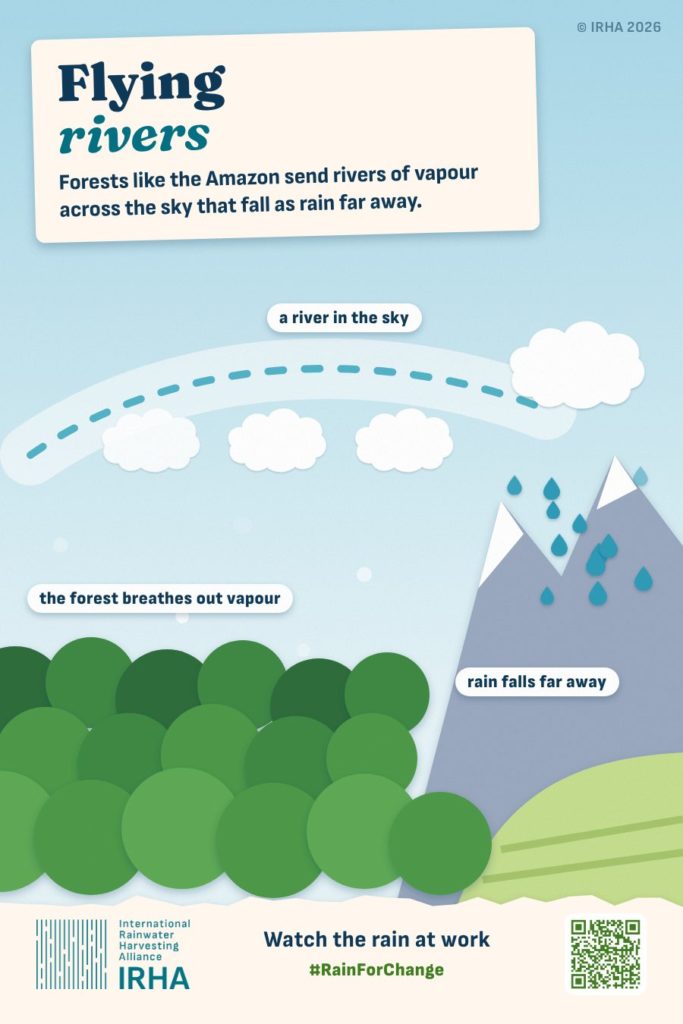
Flying rivers are streams of water vapour that rise from the Amazon rainforest and travel through the air. Part of that moisture falls as rain far away, including over the Andes, where it feeds the streams and reservoirs that cities such as Bogotá rely on. When the forest is cleared, less moisture travels on.
The link can be measured. In June 2026, the Colombian news site La Silla Vacía reported on a study by three researchers from the University of Antioquia and one from Stockholm University: between 30% and 60% of the rain that falls in the basin of the Magdalena, Colombia’s main river, comes from the Amazon and the Orinoco.
Rain is a shared resource that often begins far from where it falls. Protecting forests keeps the rain coming.
IRHA
Why it matters for rainwater harvesting
For IRHA, rain is a shared resource that often begins far from where it falls. Protecting forests keeps the rain coming. Collecting rain where it lands, on roofs, in schools and across cities, puts it to good use and eases the pressure on rivers and reservoirs.
Margarita has long described rain as a public good. In 2025, she took that message to public hearings of Colombia’s Congress, in Bogotá and in Cartagena, on the Caribbean coast.
Rethinking borders around water
Alongside Margarita, speakers from the Sociedad de Mejoras y Ornato de Bogotá, the Asociación Último Bosque and the Fundación Corazón de la Montaña looked at how borders can be rethought when water and ecosystems are at stake, starting with a question: is Bogotá an Amazonian city?
For IRHA, the session linked our Committee’s work in Colombia with our home in Switzerland. In Latin America, two national associations, ABCMAC in Brazil and AMSCALL in Mexico, are members of the IRHA Alliance, and stronger coordination in the region was on the agenda of our 2026 General Assembly. Our warm thanks to ACIS and to the University of St. Gallen for bringing Colombian voices on water and forests to a Swiss audience.
Find out more
Rain on the agenda of a national parliament: read how rainwater reached Colombia’s Congress.
Stay in touch: follow our upcoming events and our latest news.
Sources: University of St. Gallen, Latin America Week 2026 page and programme; La Silla Vacía, 1 June 2026; IRHA Annual Report 2025.