
By Rachel Nisbet
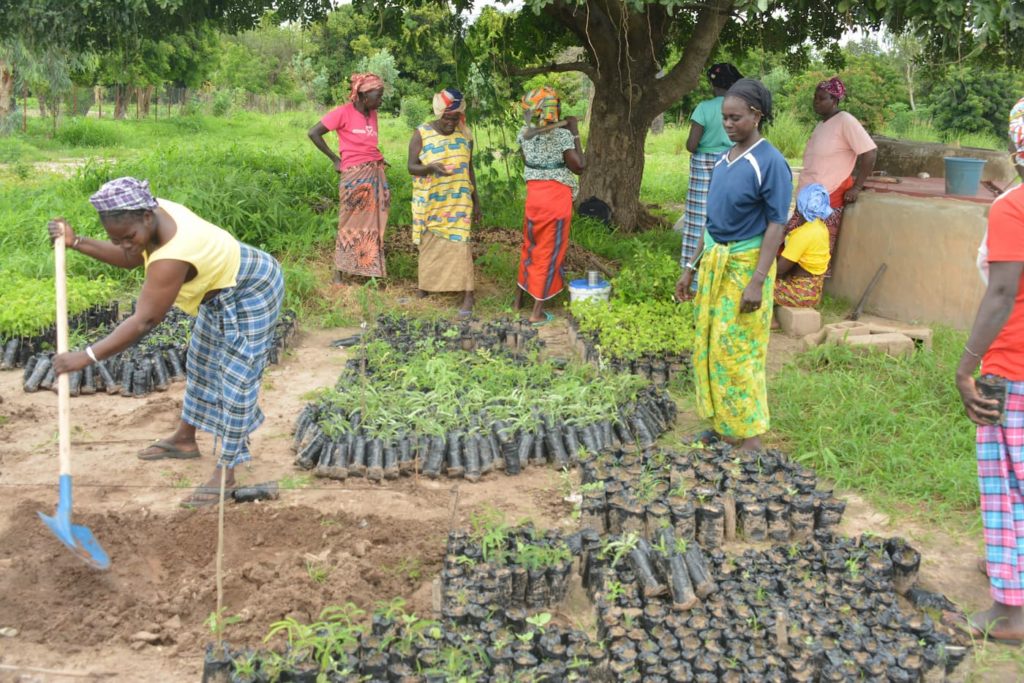
Working with committees in seven villages in the Fatick-Thiès region of Senegal, we have selected 35 local farmers, whom we will train and support to create agroforestry plots on their land. A further seven villages will be identified in 2020, and another group of about 35 farmers will be selected, trained and supported to develop agroforestry plots.
The village meetings of spring 2019 took place in school classrooms, in village squares under “palaver trees” (arbres à palabres) and in village halls, with the village chiefs present at each one. To qualify for project support, farmers had to own land, have access to a water supply and be willing to hedge and develop an agroforestry area, following the guidance of IRHA and APAF Senegal.
In the villages of Boyar Ndiodiom, Nguéssine, Djilasse, Ngarigne, Sorobougou, Loul Sessène and Ngoé, where we are working this year, local agroforestry committees are being created. They will gather the knowledge gained by participating farmers on how to plant and manage agroforestry plots and harvest rainwater for irrigation, and share it with other members of their village.
After meetings to introduce the “Rain, Forest and People” project, villagers responded enthusiastically, recognising its many benefits. One particularly motivating figure: crop yields are expected to rise by an estimated 30 to 40% once farmers establish agroforestry-style cultivation.
When building their agroforestry plots, farmers will plant boundary hedges with a range of species, including euphorbia. These spiky plants keep livestock away from valuable crops. Including euphorbia in hedges avoids the need to fence plots, a saving of about 2,300 euros per hectare. Being able to hedge her crops is a strong motivation for Mrs Bemba from Sorobougou, one of this year’s participating farmers: she says it costs her about 230 euros a year to buy euphorbia plants to stop livestock eating her crops.
Dense boundary vegetation also shelters young plants from the drying harmattan, a hot wind that blows across the region in the dry season. By also planting trees such as Senna siamea (Siamese cassia) in the hedges, farmers can produce firewood and animal fodder within their plots. A single tree could yield 52 kg of wood and 19 kg of leaves that cattle can eat. Pascal Humbert, President of APAF International, estimates that firewood can be harvested from agroforestry plots four years after planting, giving farmers up to two thousand euros’ worth of firewood a year (1,500,000 CFA francs). This technique clearly offers rural farmers a viable way to increase their income significantly. With such a promising outlook, we are very pleased to have completed the first phase of our “Rain, Forest and People” project with APAF Senegal in the Fatick-Thiès region.
Read more on the project page: Rain, Forest and People.
First published on the former IRHA website on 28 April 2019.