
By Rachel Nisbet
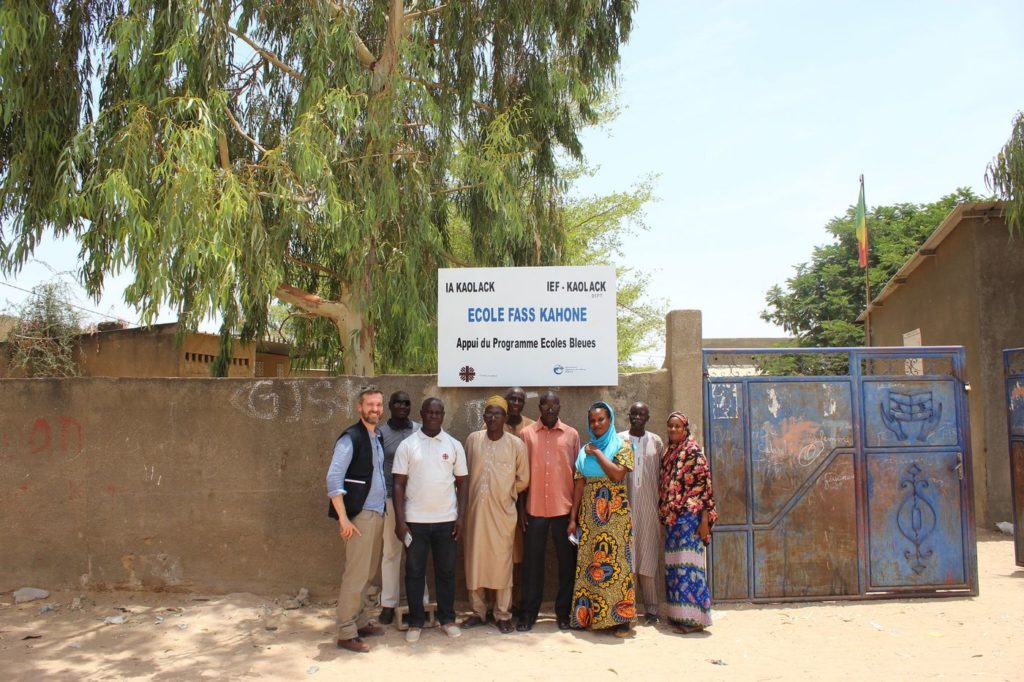
What is the value of a tree? Tree planting is one of the five components of our Blue Schools, alongside rainwater harvesting, sanitation, hygiene training and school gardens. Revisiting two IRHA Blue Schools in Kaolack, Senegal, earlier this month, Marc Sylvestre, IRHA’s Executive Director, was delighted to see the positive impact of tree planting on the local community.
The Kaolack Blue Schools were set up in 2011 in partnership with Caritas Kaolack. Returning eight years after the schools’ inauguration, we saw how deeply our partner remains committed: it acts as caretaker of the facilities we set up together. The trees our organisations planted have grown tall and shade the playgrounds. With temperatures above 40°C during Ramadan this June, these publicly accessible spaces act as oases where the community gathers to exchange news when the schools are closed. Outside teaching hours, former pupils also come back to revise for exams, enjoying the cool and calm of the courtyards and classrooms. Revising in the grounds of these Blue Schools lets the mind “withdraw into its happiness”, as Andrew Marvell wrote in his poem “The Garden”. At the primary schools of Fass Kahone and Kahone One, children appreciate the clean drinking water, the shade and the well-maintained toilets and washrooms, which help them learn. When they move on to secondary school, they take the Blue School model with them and ask for it in their new schools.
The care of Caritas Kaolack keeps these schools good places to learn. Looking after the school environment, removing rubbish, keeping toilets clean and repairing damage, in turn helps children and their communities to grow. Harvested rainwater is available at the turn of a tap, and while teachers might use it to clean a blackboard, the whole community has access to the school’s 40–50 m³ supply. Mr Diouf, president of the PEACE committee (Parents, Children, Authorities, Community, Teachers), told us how local people use it: in the dry season, they collect water to clean their toilets or for household cleaning. Having rainwater on tap nearby saves people half an hour a day that they would otherwise spend fetching water from other sources. As children often do this task, freeing their time for study is invaluable for their education.
Local people recognise that the integrated, sustainable approach of our Blue Schools improves children’s quality of life. Like all good ideas, this one has spread, and elements of the project have been copied in the wider Kaolack community. For example, Mr Moussa Sene, president of the parents’ committee and deputy of the Caritas committee, was inspired by the tree planting at the Blue Schools: lemon and orange trees now grow in his garden too, giving his family shade and much-appreciated citrus fruit.
Read more on the project page: Blue Schools in Kaolack.
First published on the former IRHA website on 10 July 2019.