
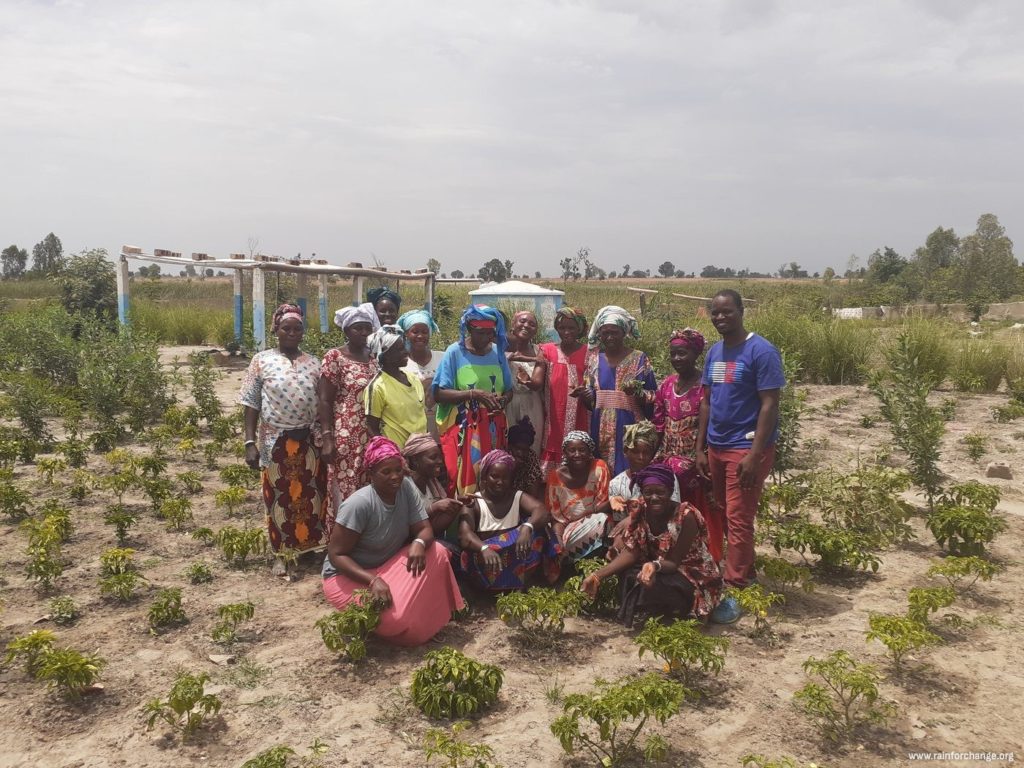
By Rachel Nisbet
Rachel Hosein Nisbet (RHN): How did you come to work with APAF Senegal?
Mansour Ndiaye (MN): I am a farmer’s son. After studying agronomy, I spent 23 years working in industrial agriculture. Since 1945, Senegal has grown groundnuts as a monoculture to supply France. I saw forests felled and chemical fertilisers and pesticides spread on newly ploughed fields, yet farmers’ yields still fell. After witnessing the harm industrial agriculture did to farmers and topsoil, I worked as an agroecology consultant for ten years, before founding APAF Senegal in 2013.
Marine Protte-Rieg (MPR): I joined APAF Senegal during my master’s in geography, because I wanted to learn about agroforestry first-hand. Leading APAF Senegal’s participatory mapping, I worked with the farming community of Diokhar village to produce maps showing the area’s boundaries and natural resources. To create a shared, visual picture of what people know about their village, we invited them to draw “mental maps”. Mapping village boundaries, watercourses and other natural resources sparked a conversation between generations.
RHN: How do the joint IRHA–APAF Senegal projects protect and improve livelihoods?
MN: The leguminous trees planted in our agroforestry projects create zones of local evapotranspiration, which favour rainfall in this arid region, while providing fodder for animals, wood for household use and shade that stops crops being scorched by the sun. Because the trees are planted throughout the fields, their roots enrich the soil with nutrients essential for crop growth. Restoring forest cover is vital in Senegal, where wood is widely used for charcoal and house building. But developing sustainable forest use remains a huge challenge.
RHN: What is your vision of food sovereignty?
MPR: The concept of food security is about people being fed with sufficient food. Food quality comes second, and people’s ability to secure their own food is overlooked. Looking at nourishment through the lens of food sovereignty makes the link between the health of ecosystems and public health. The word “sovereignty” empowers people, affirming their right to decide how they grow food. It also invites them to take responsibility for their actions.
RHN: How will farmers in the Thiès and Kaolack regions look after themselves, their crops and their livestock while following the hygiene measures needed to protect themselves during the COVID-19 pandemic?
MPR: The household rainwater tanks called “calabash”, built for all farmers taking part in our joint IRHA–APAF Senegal projects, have considerably increased their drinking-water supply. Mrs Ndoug from Boyard village told us how her household’s 5,000-litre tank supplied water for her family of 15 between August and December 2019.
MN: As drinking water, it is of better quality than tap water in the Thiès region.
MPR: Moreover, when the tanks have been emptied of rainwater, families use them to store tap water. Water cuts can last for months, so a household water reservoir is invaluable now that handwashing is vital to prevent the spread of COVID-19. In households that often have twenty members and are far from health services, a decentralised water supply is essential for good hygiene as the pandemic continues.
RHN: The UN has warned of famine following the COVID-19 pandemic. How vulnerable are the farmers involved in our projects?
MN: The “Rain, Forest and People” project is designed to counter local soil degradation by planting leguminous trees. In total, APAF Senegal has planted 1,500,000 trees in 100 villages. After just three years, these trees mature enough to begin restoring soil fertility. But the first three years are hard. In 2019, the rainy season lasted less than two months, which makes watering saplings difficult. In the first year, roaming livestock can graze on the young trees if fields are not guarded. We plant thorny hedges around each plot, but these living barriers take two years to become effective. Farmers need to be out in their fields to care for their crops and young trees.
Patience is a great virtue, and farmers in the Thiès region have great fortitude: they replant their fields if a crop does not germinate, for example. But they are tired. For ten years, rainfall has decreased locally. The water table has dropped and wells are running dry. Farmers grow fewer cereals and harvests are poor. They have little money. The nutrient-poor soil dries in the sun and the wind blows it away. Throughout Senegal, communities have a strong tradition of sharing meals and resources, but as harvests shrink, there is little left to share.
The virus adds yet another pressure. Because of the lockdown restrictions, we cannot pot new saplings in our nurseries or monitor older plants for pests. Fortunately, we had completed the information sessions on the “Rain, Forest and People” project for a second group of farmers, and for those involved in the new project in Kaolack. I hope we can get back to the nurseries before the rains.
Read more on the project page: Rain, Forest and People.
First published on the former IRHA website on 29 May 2020.