
By Han Heijnen
Following the two-day Regional Rainwater Conference held in Kathmandu on 18 and 19 March, Florian Bielser, IRHA Programme Officer, and Han Heijnen, President of IRHA, joined Nirmal Adhikari, programme coordinator of our partner Kanchan Nepal, for a ten-day field trip to Chitwan and Kaski districts.
The purpose of the visit was to see how the IRHA-supported projects in the two districts had evolved, and to strengthen collaboration between Kanchan Nepal, Sapana Village Social Impact (SVSI) from Sauraha, Chitwan, and Local Initiatives for Biodiversity, Research and Development (LI-BIRD) from Pokhara in the recently started Rain Communities project.
Chitwan
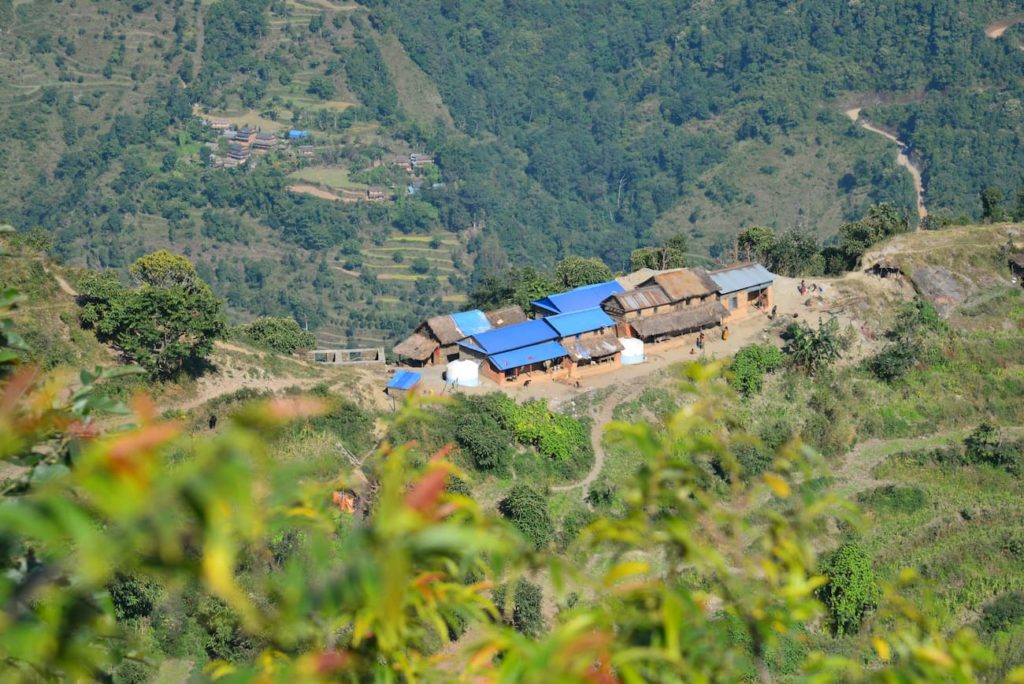
Our first stop was the house of Shreerendra Pokharel, on the edge of Chitwan District. Shreerendra has long been a partner in Kanchan Nepal projects, demonstrating ecological sanitation, the use of urine as fertiliser in vegetable farming and ways of turning plastic waste into useful household items. After a late lunch we headed into the interior of Chitwan, bordering Dhading District. The area is hilly, rising to about 1,800 m, and rather bare. The Chepang communities who live here are poor and find it hard to make a living, which has left a landscape with few trees and forest reserves. In earlier projects, Kanchan Nepal and IRHA supported SVSI to build rainwater systems for households in the upper reaches of the hills. This has helped the community become more economically resilient, for instance by developing homestay bed-and-breakfast facilities.
The current project has a broader focus on Rain Communities: making communities more climate-resilient by introducing a range of good practices in agriculture and landscape regeneration. This goes beyond Kanchan Nepal’s technical capacities, which is why the project has brought in SVSI in Chitwan and LI-BIRD as partners.
Dharma Raj Dhakal, SVSI field coordinator, joined us in Chitwan and explained SVSI’s contribution. One part of it is the revival of fodder trees for livestock: at every stop he shared tree seeds with the community, promising to buy surplus seedlings and, in due course, the seeds of the grown trees. It was good to see how well organised the women’s group we met in Chappdanda was. Several women now had rainwater storage and welcomed SVSI’s extra support for vegetable gardening. The recent agroecology training facilitated by SVSI and LI-BIRD was clearly already bearing fruit.
Two Blue Schools
IRHA’s Blue School programme has supported two Blue Schools in Chitwan in the past two years, and it was good to visit them and see how children and teachers benefit from the facilities. At Janapriya Blue School, Nirmal has installed a weather station to monitor rainfall. As it is a secondary school, the station will also help pupils carry out practical projects as part of the curriculum. The weather station is linked to the national network and its data will contribute to better local weather forecasts.
The next day we visited Adarsha Blue School. The project was completed in December 2023, and the children were enjoying the water and the toilets. The headmaster and teachers were very pleased with the result of the joint effort. The school management was still choosing native trees and shrubs to plant around the school compound.
Later we met Dhruba Giri, chair, and Sujan Basnet, programme director of SVSI, who had travelled two hours by motorbike from Sauraha to meet us at Mayathar, near Gurkhes, another of the Rain Communities. Over lunch we got to know each other and discussed the start of the joint project.
Kaski
In Kaski District, the focus was on strengthening resilience by restoring traditional ponds (pokharis) and identifying sites for new ones that could store water at higher elevations. Some possible locations were discussed with community members. In Madi Rural Municipality, we discussed with the mayor the rehabilitation of 30-year-old water supply systems. Some still work, but declining spring yields cause seasonal shortages. The Rain Communities project will look at options to improve the situation in a joint effort between Kanchan Nepal, the municipality and the people. The 3D models of the area that Kanchan Nepal has made through participatory processes will support better decisions on managed aquifer recharge through ponds, bunds and other ways of slowing run-off in the landscape.
An important component introduced by LI-BIRD is the community seed bank. Traditional local seed varieties that have proved reliable in the area are collected from farms in the community. The Department of Agriculture inspects the farms before planting, during growth and after harvest. If all is done well, the seeds are certified and stored for future use in the area. As well as keeping a store of good seed, the plan is to gradually increase the stock and variety of indigenous seeds.
In Pokhara, we concluded the programme with a discussion between all three partners at the LI-BIRD office. Partners presented their planned activities for the Rain Communities project and the progress so far. The project was clearly going well, with two more years to make the results gradually visible in the community.
A worthwhile trip, with plenty of exercise and many opportunities to talk with people and partners about this important effort to build climate-resilient communities through better use of rainwater.
Read more on the project pages: Rain Communities Nepal – Phase 2 and Blue Schools Chitwan.
First published on the former IRHA website on 25 April 2024.