
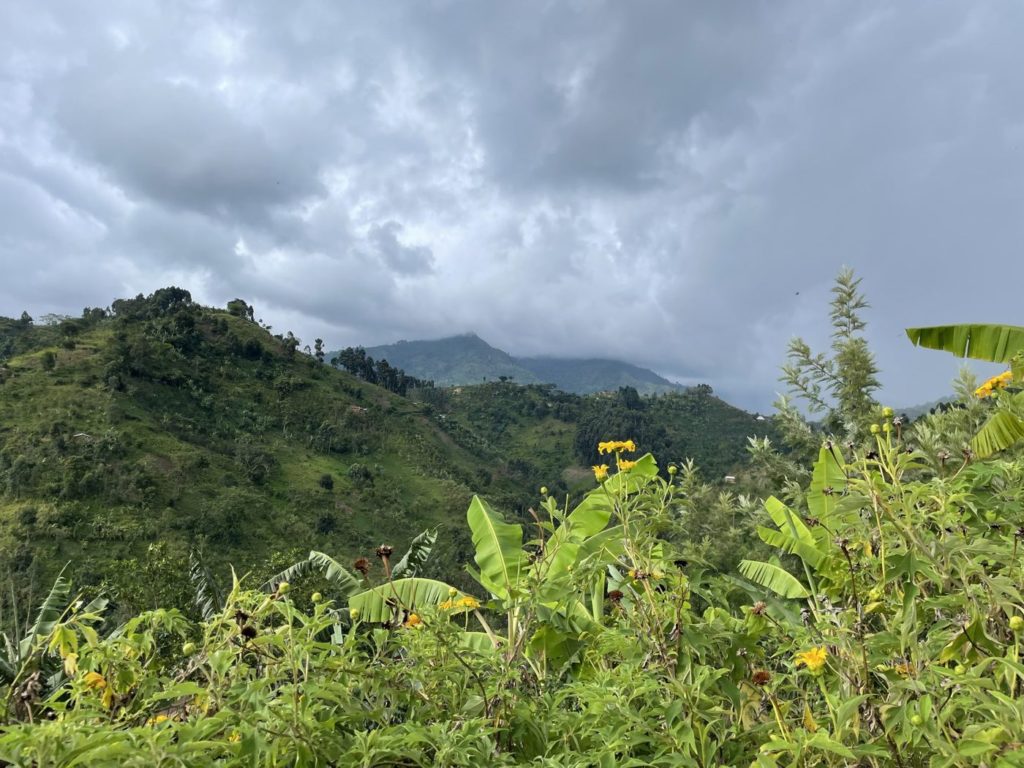
In Kasese, in western Uganda, water now reaches 21 schools, 15 local masons have been trained and two low-cost designs are being tested in people’s homes: Caritas Kasese and IRHA are working towards affordable rainwater harvesting for rural households.
Since early 2022, our partner Caritas Kasese has been building calabash rainwater tanks across Kasese District. The work began with a school water supply programme that brought water to 21 schools serving more than 10,000 children. In 2023 and 2024, a further 18 schools, parishes and private households followed.
Masons trained locally
The first training came from the Clean Water, Healthy Village calabash training centre in the Maasai Mara, Kenya. Caritas Kasese has since trained its own masons. Today, 15 masons, 11 men and 4 women, are proficient in building rainwater harvesting systems.
Water in schools is about more than tanks. All the schools have also received training in making reusable menstrual pads, and most of them now produce liquid soap as part of the programme.
The programme has been financed by private donors. IRHA President Han Heijnen provides technical support, and IRHA follows the work on its Support to Caritas Kasese project page.
From schools to homes
So far, most of the systems built are institutional. A few middle-class households have asked Caritas Kasese to build a system for them. The next question is how to bring the cost within reach of rural families.
In September 2024, Dr Terry Thomas, formerly of the Development Technology Unit at the University of Warwick in the UK, contacted IRHA to discuss affordable domestic rainwater harvesting in Uganda. The discussion quickly led to a suitable design and a plan to test it: the mini rainwater harvesting system, or mini-RWH.
Two options are now being compared:
- The mini-RWH, built around a 500-litre polyethylene tank, for around UGX 370,000, a little over USD 100. Rainfall in western Uganda ranges from 1,000 to 1,500 mm a year. In the Rwenzori Mountains, such a tank would not serve a household every month of the year, but it would come close. It can be installed in one day, transport included.
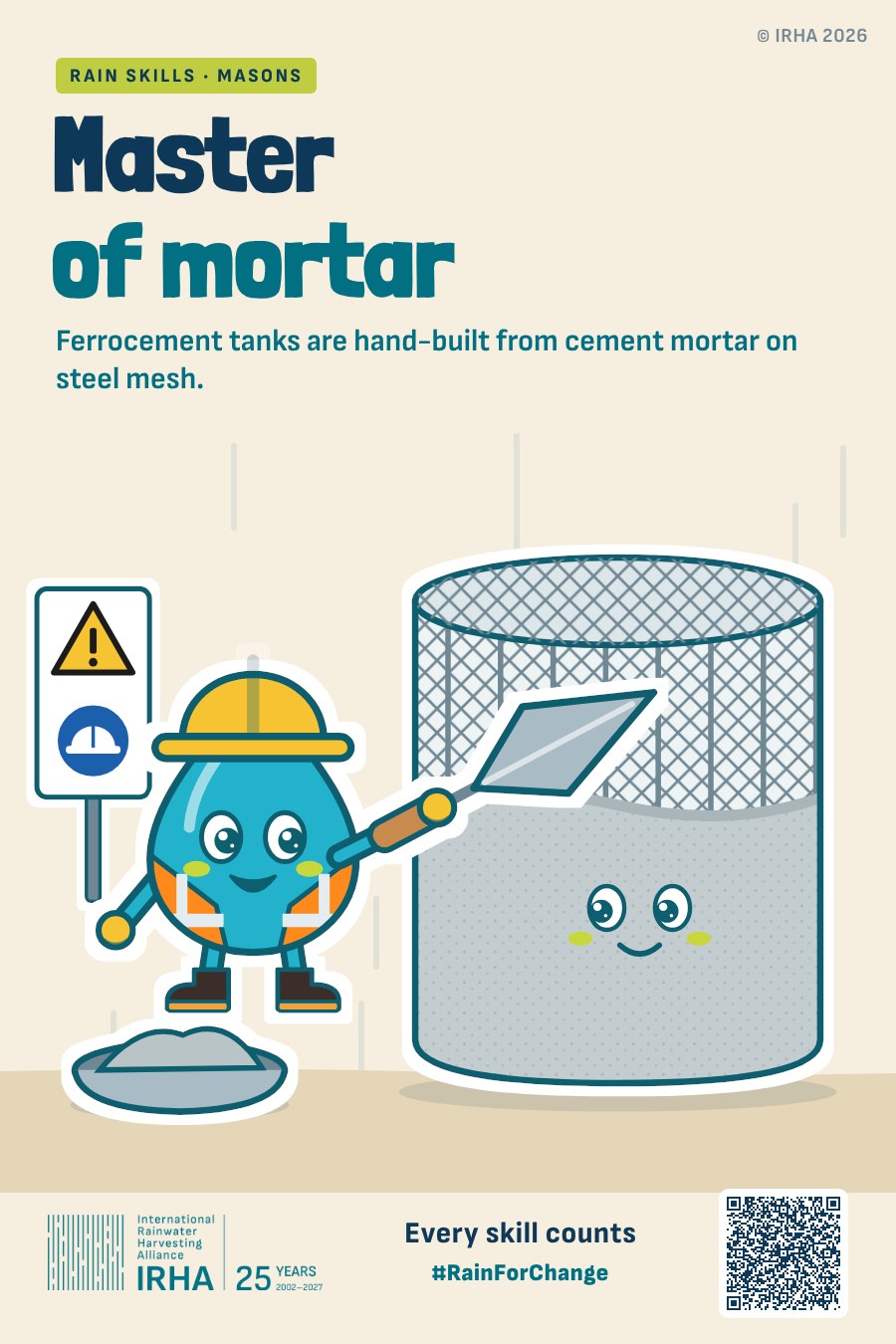
- The 2,000-litre calabash, a ferrocement tank of the kind described in our Calabash Tank Manual, designed by Caritas Kasese with IRHA’s assistance, at a cash cost of UGX 616,000 (USD 162). It holds four times the volume and is sturdier, and the household contributes some support in kind. It takes six half-days to complete, so two masons can build two of them in a week. It would benefit from a larger roof area.
| Mini-RWH | 2,000-litre calabash | |
|---|---|---|
| Tank | 500-litre polyethylene tank | Ferrocement tank, four times the volume |
| Cash cost | About UGX 370,000 (a little over USD 100) | UGX 616,000 (USD 162) |
| Building time | One day, transport included | Six half-days; two masons can build two a week |
| Household contribution | – | Some support in kind |
Affordable rainwater harvesting, tested in real homes
In February 2025, Han Heijnen visited Caritas Kasese for consultation and training, and to start a research activity: testing the two designs for cost, user satisfaction and functionality, and looking for possible improvements.
Victor Turyamureba of the Development Technology Workshop in Kampala installed two mini-RWH systems in two different climatic areas. Caritas Kasese had already built two 2,000-litre calabashes, and two more were built during the visit.
One of the systems stands at the home of a member of St. Mary’s Women Group in Kasanga, where Caritas Kasese also runs a micro-finance scheme. The women of the group jointly own a heifer, which they hope will calve in a few months, and the animal needs water. Every day, the women record the water-meter readings, and their records feed directly into the test.
What comes next
The aim is to lower the cost of a simple rainwater harvesting system so that a rural household can afford it. Offering a choice of options may help households extend their supply beyond the rainy periods and keep stored water for most of the dry season. First results are expected towards the end of 2025.
The work also points to an opportunity for local artisans: masons and plumbers who can build rainwater systems and earn a reasonable living from it. Financing remains a hurdle for households, and Caritas Kasese will look into micro-finance options.
Update, February 2026: Dr Terry Thomas has written up a year of mini-RWH trials across Uganda: read what the trials taught us.
Stay in touch: follow our upcoming events and our latest news.
Added to our news archive in November 2026.