
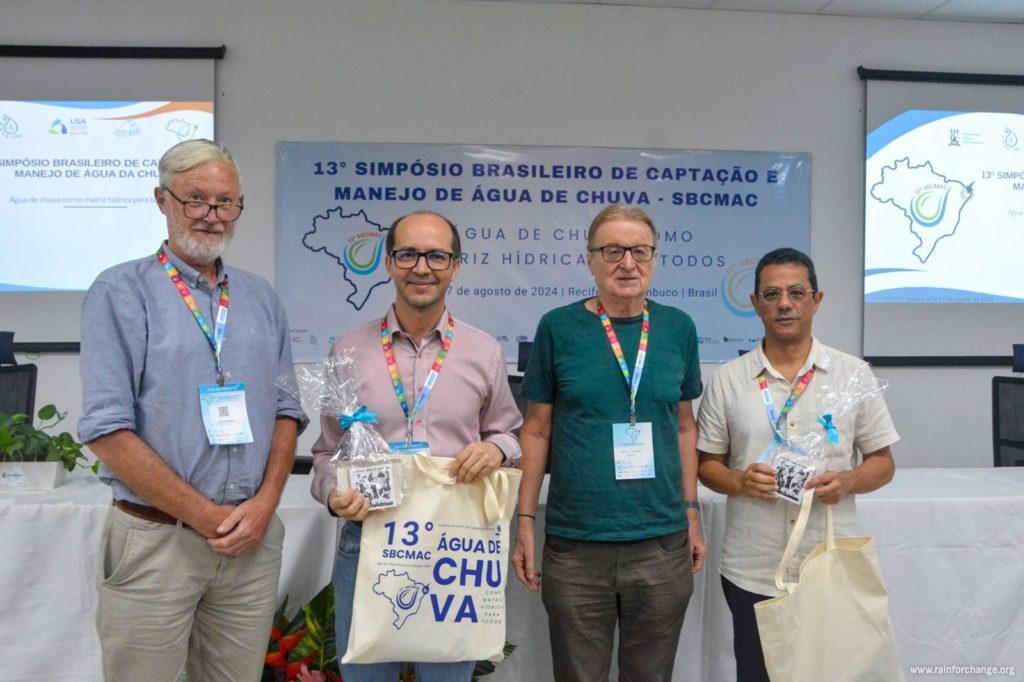
By Han Heijnen
Laws, safe drinking water, start-ups and floods were on the agenda when the Brazilian rainwater association met in Recife.
IRHA’s partner in Brazil, the Associação Brasileira de Captação e Manejo de Água de Chuva (ABCMAC), held its 13th symposium in Recife, in the state of Pernambuco, from 25 to 27 August.
Pernambuco lies in north-east Brazil, a semi-arid region where ASA, an umbrella organisation of local NGOs, has successfully implemented a rainwater harvesting programme for one million people. Around a hundred people from government, universities and NGOs attended the sessions.
The presentations covered the challenges of implementing rainwater harvesting projects, the need to update laws so that harvested rainwater can be used more widely, and the technologies that can make rainwater safe for domestic drinking water supply.
To build the capacity to take on projects, the private sector needs to get involved. The overview presented was promising, and a number of start-ups had the chance to present their projects.
In 2024, Brazil faced severe flooding in the state of Rio Grande do Sul. Key aspects of water resources and rainwater management were therefore reviewed and discussed in the light of the accelerating effects of climate change. Considerable effort is needed to improve protection against floods while keeping enough water in the landscape.
Desertification is a growing problem in several parts of Brazil and needs to be halted. This will mean enforcing and updating existing laws, particularly those on nature and water conservation.
Han Heijnen, President of IRHA, was invited to give the keynote address, in which he looked at the opportunities for rainwater harvesting in rural areas, cities and industrial zones.
Many participants joined the field visit to the community of Morro Alto da Telha, a favela in Passarinho, in the western part of Recife. The houses sit on a steep hillside, and most of the time the city’s water supply does not reach them.
Because of the lack of space, the poor bearing capacity of the soil and the doubtful quality of construction in this self-built area, the design is rather unusual. The upper tank holds 1 m³, with a further 300 litres of storage below ground. The structure is made of fibreglass, with stiffening supports where needed.