
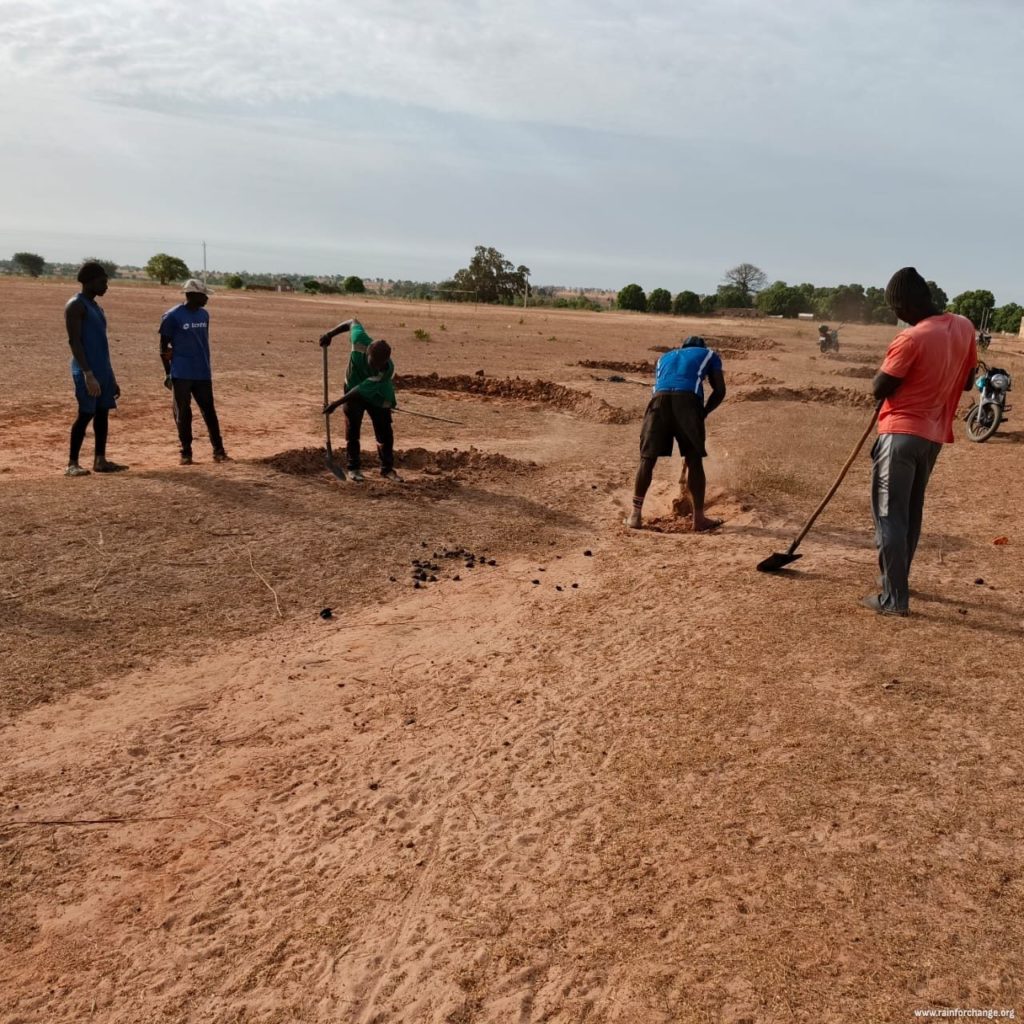
In February 2025, IRHA visited villages of the Transition to Agroecological Ecosystems project, run with Caritas Kaolack in Senegal.
The context
The groundnut basin around Kaolack lives mainly from farming and has been one of Senegal’s main areas of emigration since the farming crisis of the 1970s. Low farm productivity and few jobs weaken family incomes. Climate change makes droughts and heavy rains more extreme, speeding up the loss of soils, biodiversity and ecosystems. Since 2021, with Caritas Kaolack and funding from the Fédération genevoise de coopération (FGC), farming communities in the Wack Ngouna district have been moving from traditional rain-fed farming towards resilient, agroecological practices.
What we saw in the fields
- Half-moons and ridges that catch run-off and help the soil hold water
- Anti-erosion bunds and gabions that slow the water down
- Calabash tanks storing rainwater next to the fields
- Vegetable plots in the villages
- A sand quarry that the community plans to turn into a bouli, a pond that keeps rainwater on the land
Farmers also told us, on camera, what these techniques have changed for them. Their testimonies will help us share the approach with other communities.
Building on earlier work
The visit built on work that began earlier in the project. In May 2023, for example, more than 50 villagers in Ndayène Poste installed 70 metres of gabions and about 60 metres of stone lines in three days, with ASGEP, the Senegalese rainwater association, supporting the anti-erosion work.
The project was designed to support 320 producers in four activities – market gardening, rice growing, tree planting and beekeeping – and to reach 6,280 community members, 3,100 pupils and teachers, and 255 municipal and technical staff. Its goals included treating half of the erosion-prone sites, rehabilitating three of six rainwater retention areas and reforesting a “School of Ecosystems” as a living laboratory.
What comes next
The visit came a few weeks before the end of this phase. The work continues with Caritas Kaolack in a new project, Transition to Resilient Territories (2025–2028).
Read more on the project page: Transition to Agroecological Ecosystems, and on its follow-up, Transition to Resilient Territories.
Added to our news archive in November 2026.