
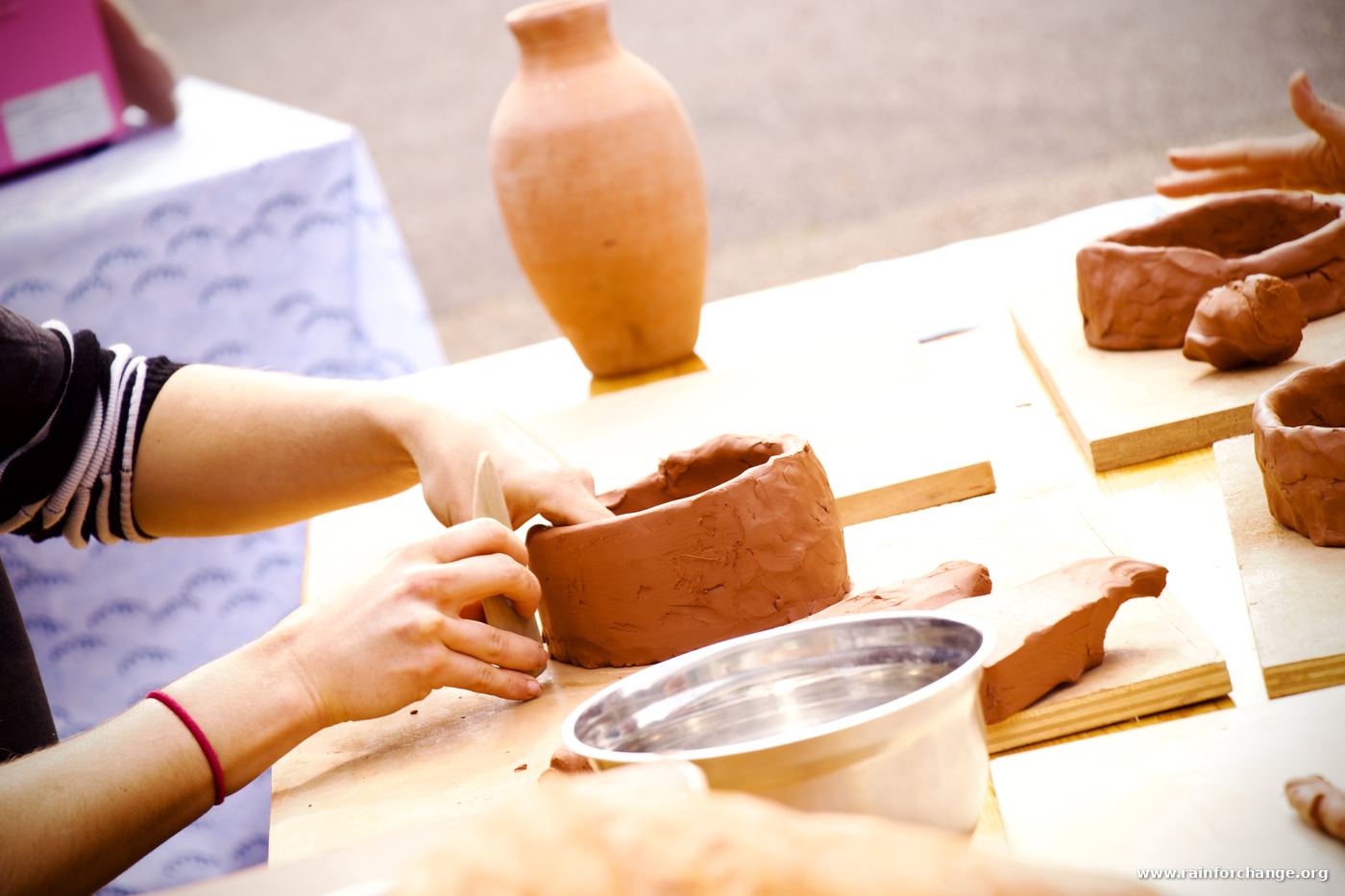
July had not been kind to Geneva’s gardeners. Yet when the clay came out at the first Garden Party of Genève Cultive on Saturday 26 July, the workshop table filled up quickly, and ceramic artist Annabelle Voisin ended up running it longer than planned. Genève Cultive is the association that brings together urban gardeners in Geneva, Switzerland, helps them share skills and maps local growing projects on an interactive map. It is also our partner in PluiË, and we were delighted to be invited to its first party.
The workshop was called « Cér’averse », a play on céramique and averse (a downpour). From 16:30 to 18:00, the team of PluiË, IRHA’s awareness project on rain in Greater Geneva, and Annabelle, of Céramiques des Subsistances and the ceramics association Caractère Inverti, our fellow rain keeper in clay, guided participants as they built their own irrigation jar with the coil technique: roll the clay into long ropes, stack them in rings, smooth the walls, and a jar slowly rises from the board.
A jar that waters from below
An oya is not a decorative pot. It is a tool, and a very patient one.
How an oya works
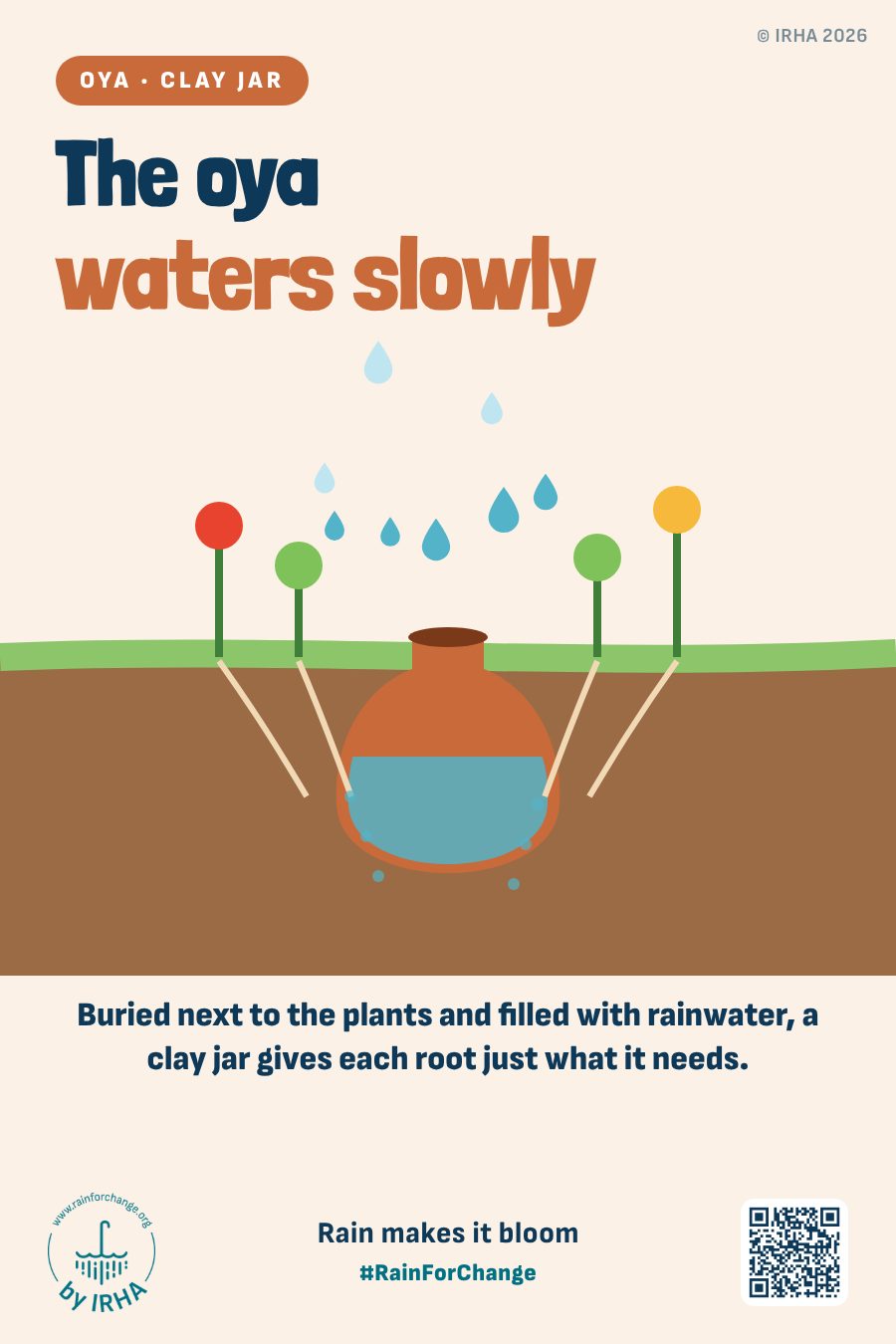
- Bury it. Dig a hole next to your plants and set the unglazed clay jar in it, with the neck just above the soil.
- Fill it. Pour in water, ideally rainwater you have collected from a roof or a barrel.
- Let it seep. The water passes slowly through the porous walls and reaches the roots directly, so less is lost to evaporation than when you water the surface.
- Cover it. A saucer or a flat stone on top keeps out leaves and insects.
- Top it up. Refill regularly, more often in hot, dry spells.
Sources: SSWM toolbox, manual irrigation; FAO family farming knowledge platform, pitcher irrigation.
From Geneva gardens to farms far away
Clay pot irrigation is far from a Geneva invention. The FAO’s family farming knowledge platform, for example, shares a training video on pitcher irrigation from India (FAO). For IRHA, the oya connects two things we care about: using every drop where it does the most good, and making rainwater part of everyday gardening in town. Rainwater is too precious to be wasted on a pavement when it could be waiting in a jar next to a tomato plant.
The jars made on 26 July will now be fired and spend the winter safely stored. Genève Cultive plans to plant them in its gardens next spring.
Garden groups, schools and associations: clay-jar workshops are part of the PluiË activity catalogue (in French). Book one and make your own oyas, then fill them with rain.
The next clay workshops will appear on the IRHA events calendar; our News & Media page has the rest of the PluiË news.
Update, May 2026: Genève Cultive planted the jars from this workshop on Wednesday 6 May 2026 at the Jardin des Nations, a garden in Geneva’s international district, during the Explore Demain festival. IRHA joined with a rain walk and a garden-water workshop, « Agis pour ton jardin et comprends l’eau ! » (read the news in brief). Another jar-making workshop followed on 17 May at Centre Nature La Libellule, where our partner La Libellule runs nature outings and workshops for the public.