
On the morning of Thursday 20 February, the new pavement of chemin De-Maisonneuve in Vernier, a town on the Rhône in the canton of Geneva, Switzerland, looked like any other: grey and dry. By the time the schoolchildren arrived, it was covered in messages nobody could see.
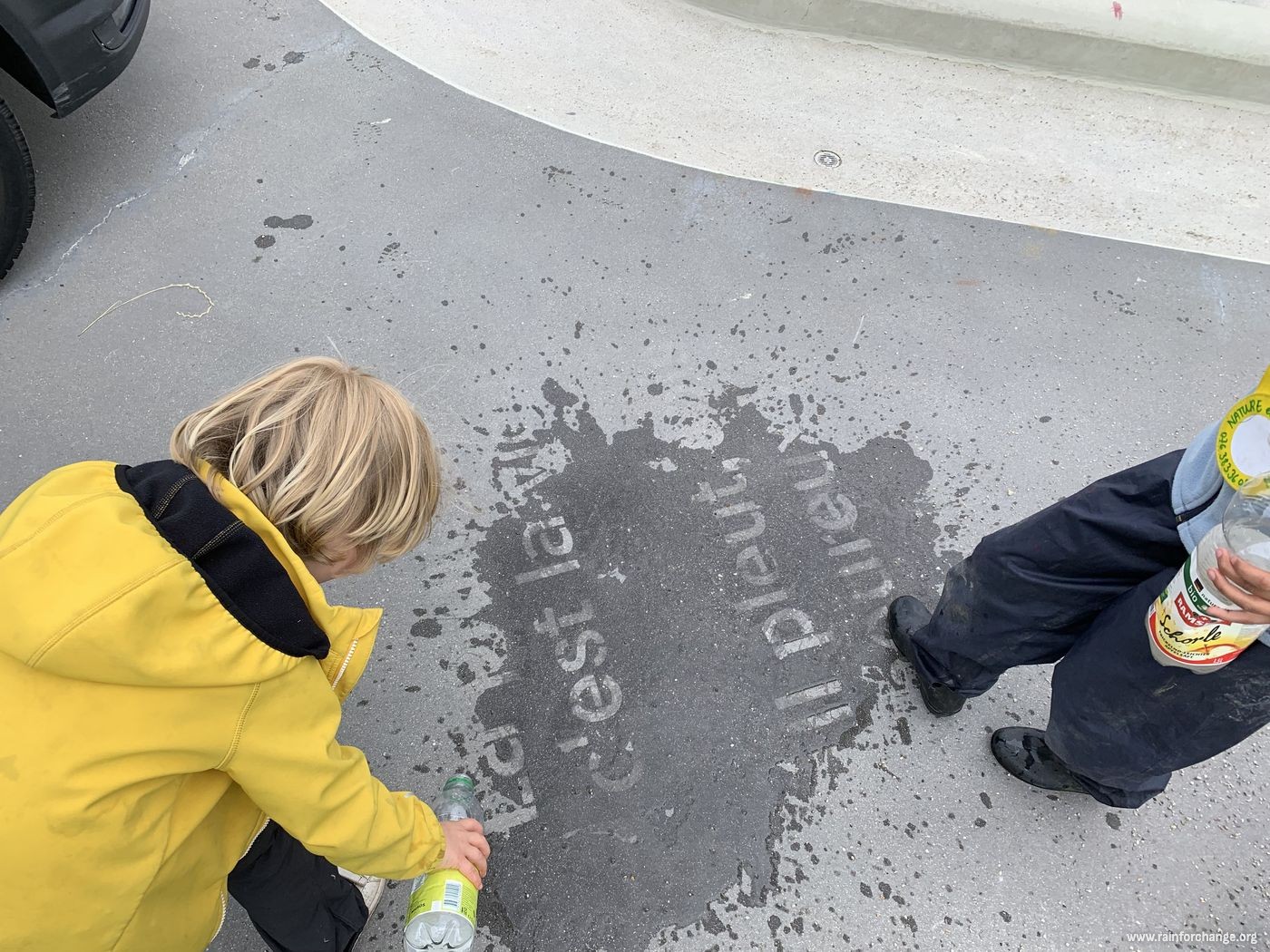
We had tagged the whole pavement early that morning with our PluiË stencils, after testing a patch on 13 February. The product is transparent and water-repellent, so it stays invisible on dry ground. Then a fire-hydrant hose fitted with a rain-effect nozzle swept over the pavement, the concrete darkened around the letters, and the words came through.
A street built to water its own trees
The occasion was the inauguration of the redesigned street, organised by the City of Vernier’s planning department (Service de l’aménagement), which designs the town’s streets and public spaces. Vernier invited PluiË, our awareness project on rain in Greater Geneva, to take part. Chemin De-Maisonneuve has been rebuilt so that rain falling on the road and the pavement runs into the pits of its new trees instead of going straight down the drain.
That is easy to say and hard to see. So the City asked IRHA to make it visible: to show the children, and the adults with them, how water from the road and the pavement finds its way into the tree pits. With the hose running, the path of the water from pavement to tree pit was there for everyone to follow.
Three languages, one logo and a dance
The stencils, one metre by one metre, were funded by the City of Vernier. The messages are in French, with English and Spanish versions, and carry the IRHA logo and #RainForChange. If you pass by after a shower, look down.
Then it was time to move. With our fellow rain keepers of Global Water Dances – Geneva, dancers who use movement to draw attention to water, the pupils joined a participatory rain dance, feeling with their whole bodies what the stencils say in words.
This street is part of a wider shift. Under its Eau en ville approach, the Canton of Geneva treats rainwater as a resource rather than as waste to be piped away, and communes such as Vernier are putting that into practice. Rain sent to the drains is gone in seconds; rain kept in the soil feeds the trees and cools the street.
We hope to come back on a fine day and tag the pavements along the whole street. If messages hidden in the pavement are new to you, read how the first Tags de PluiË were unveiled on the Pont de la Machine in 2024.
Communes and schools: rain tags, rain dances and rain walks can be booked for a new street, a playground or a school week. Find out more and get in touch on the PluiË project page.
Follow our upcoming events, from rain walks to rain tags, on the IRHA events calendar and our News & Media page.
Update, October 2025: in May we sent the PluiË activity catalogue to the school and offered a year-long programme, and in August we proposed the “Vis ma pluie” exhibition to the City and the school. After a field visit in September, the canton published figures for the street: about 2,400 m² of road disconnected from the stormwater network, 14 new trees and an estimated 2,000 m³ of rainwater a year kept out of the drains (Eau en ville blog).
Source: Canton of Geneva, Eau en ville blog, « Eau en ville à Vernier », 8 October 2025 (field visit of 18 September 2025).