
By Rachel Nisbet
Our collaboration with the local NGO Kanchan Nepal has supported its work in “empowering communities with water, sanitation and health services”. Despite the heavy rainfall it receives during the monsoon, Kaski District is water-stressed. It is made up of steep-sided valleys, mainly of limestone (karst), so water tends to flow underground, which makes collecting surface run-off difficult (Rimal et al., 2018). Providing a reliable supply of drinking water to rural communities through rainwater harvesting is therefore vital in this district. Building toilets, as we have done in our Nepalese Blue Schools, is also important, since only 62% of the population of Nepal has adequate access to sanitation (FAO, 2011; WHO/UN-Water, 2014).
Our partner, Kanchan Nepal, has its headquarters in Pokhara, Nepal’s second-largest city and a gateway for many trekkers heading for the Annapurna range. To date, we have helped Kanchan Nepal build eight of ten planned Blue Schools east of Pokhara, in Kaski District. This has given 757 children access to drinking water and handwashing facilities at school. The rural schools we have turned into Blue Schools with Kanchan Nepal are up to 14 km from local springs. Being able to harvest and store rainwater at school therefore frees children, often girls, from the arduous and time-consuming task of fetching drinking water. In addition, given the sustained and largely unplanned urbanisation of Pokhara’s outskirts, providing drinking water to rural communities in Kaski District can help slow migration towards Pokhara, where the municipal supply meets only 50% of local demand (Republica, 2014).
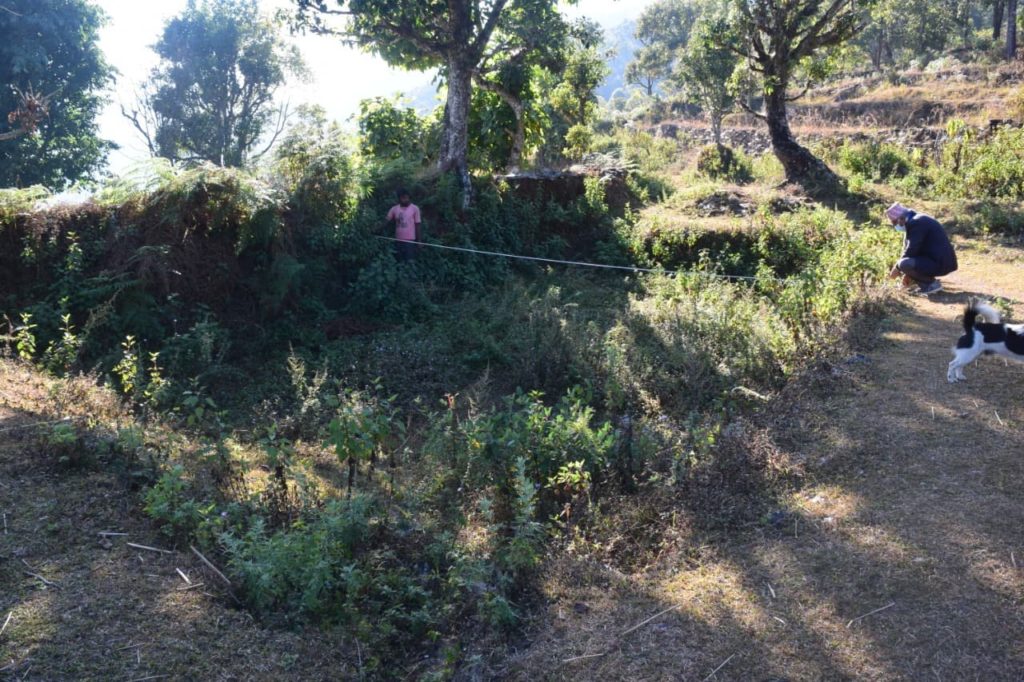
In Nepal, our Blue Schools project has adopted the traditional local method of harvesting rainwater in shallow ponds. As Scott et al. (2019) observe, using many small ponds avoids building dams, which displace local people and trap river sediment. With Kanchan Nepal, we have restored local ponds so that they store rainwater and recharge groundwater. Restored ponds reduce surface run-off by creating many places where rain can collect and then gradually soak into the ground. Combined with tree planting, this technique offers a holistic way of preventing soil erosion. We included tree planting in the Blue Schools we built at Indrayani, Ramkot and Arunodaya, where our “A child, a tree” campaign planted 250 trees. The next phase of our work in Nepal will focus on managing watershed run-off in other areas.
Eight years of experience in collecting rainwater as a safe drinking-water source and for crop irrigation in these mid-hills, and of using greywater for school garden plots, have given IRHA an in-depth understanding of rainwater management at micro-watershed scale. Rainwater harvesting gives communities a secure supply of drinking water despite year-to-year variations in rainfall. It is also a way of managing watersheds sustainably and preventing soil erosion.
Further reading: The Hindu Kush Himalaya Assessment (Springer, 2019).
Read more on the project pages: Rain Communities Nepal – Phase 1 and Blue Schools Nepal – Pokhara Region.
First published on the former IRHA website on 20 February 2019.