
Rainwater harvesting is the collection, storage and use of rainwater from surfaces such as rooftops or land, to improve water availability for households, agriculture and ecosystem restoration. That is the definition in IRHA’s technical glossary, and it covers two families of techniques: catching rain from roofs to store it for people, and slowing rain on the land so that it soaks into the soil and recharges groundwater.
The five techniques below are low-cost, built with local materials and maintained by communities. Each one has its own sheet in IRHA’s technical fact sheets, written with the food sovereignty platform of the Fédération genevoise de coopération after a workshop in Senegal in 2024.
1. The roof rainwater system
A roof, gutters and a storage tank are enough to provide water close to home. In IRHA projects, the tank is often made of ferrocement: its thick, opaque wall keeps the water fresh and prevents algae. A first-flush device diverts the first rain, which washes dust and impurities off the roof, and a grid and cloth filter the water at the tank inlet. The tap is placed about 30 cm above the bottom so that sediment stays behind. Regular roof cleaning and a full clean of the tank every two years keep the water good.
2. Half-moons
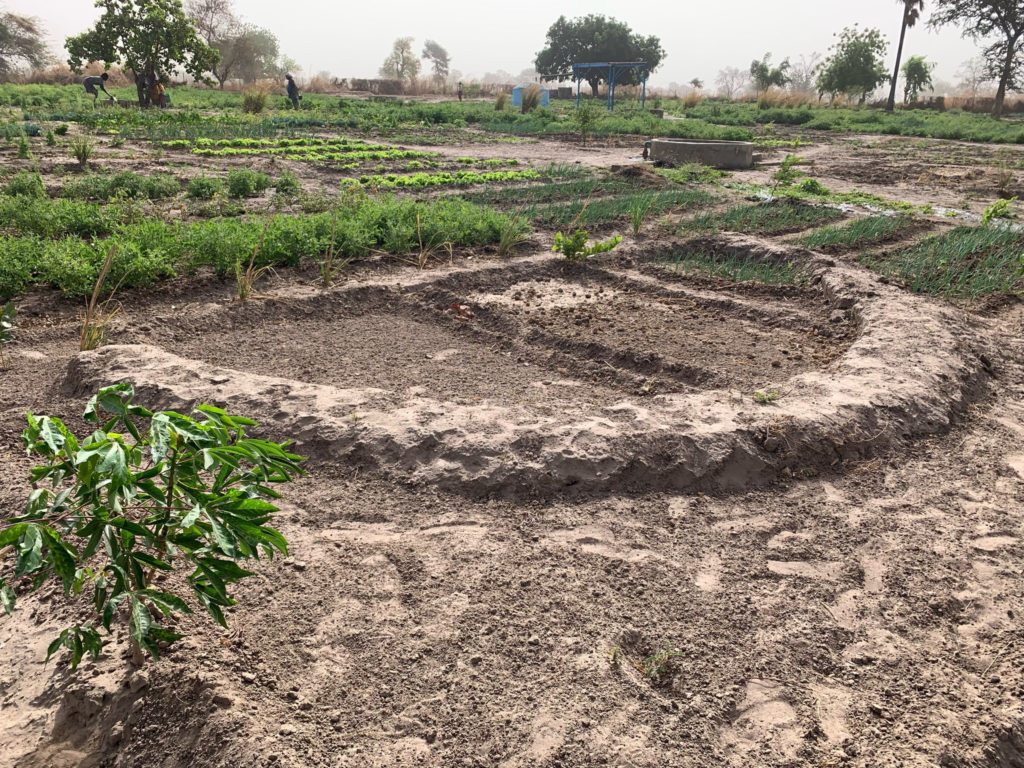
Half-moons are a traditional Sahelian technique: shallow semicircular basins, 2 to 3 metres across and 30 to 50 cm deep, dug in staggered rows and filled with compost or manure. When it rains they act as water traps. Crops sown along their edge can draw on this reserve during dry spells, which makes them less dependent on irregular rainfall.
3. Vegetated stone bunds
Lines of stones laid along the contour slow run-off, let more water infiltrate and reduce erosion. A shallow anchor trench holds a first row of large stones, reinforced on the lower side by smaller ones. Planting grasses or shrubs such as vetiver along the bund makes it stronger every year.
4. Gabions in gullies
Where run-off has already cut gullies, gabions – stones wrapped in wire mesh – act as filtering dams. They slow the water, trap sediment and gradually heal the gully. A series of small gabions, a few metres apart, works better than one large structure. In Senegal, villagers in Ndayène Poste built 70 metres of gabions and about 60 metres of stone lines in three days in May 2023.
5. Retention ponds
Natural depressions can be deepened to store water after the rainy season for livestock and vegetable gardens, and to recharge groundwater. In Senegal they are called boulis, in Nepal pokharis. Planting vegetation around them reduces evaporation and creates a cooler, more humid microclimate. A management committee, secure land rights and community maintenance keep them working.
Start with the landscape
No single technique fits everywhere. IRHA’s approach links water, soil and trees: catching rain where it falls, protecting the soil and planting trees that hold both together. Communities first map their land and agree on an action plan; techniques come next.
Download the IRHA technical fact sheets (PDF) and discover our projects.