
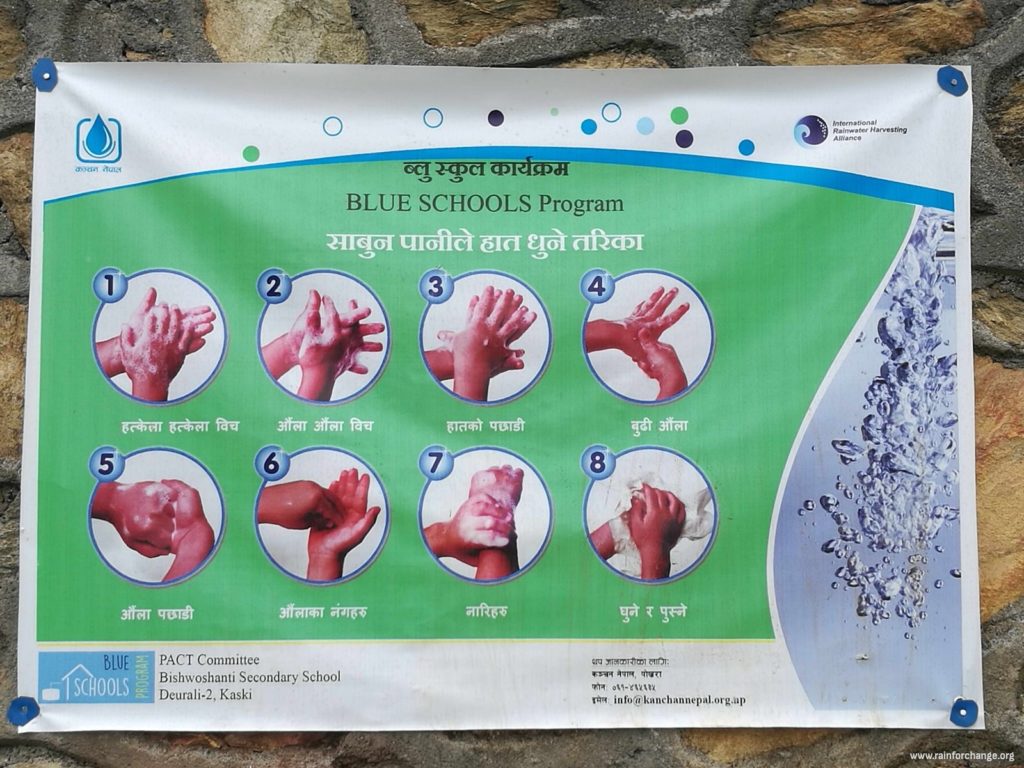
With our long-standing partner Kanchan Nepal, a Blue School project in Nepal brought rainwater, toilets and handwashing stations to a school community in 2024, together with a committee to look after them.
Why schools need water
In Nepal, nearly 20% of public schools lack improved water and sanitation. Even where facilities exist, they often do not meet pupils’ needs, especially those of girls. The result is absenteeism, health risks and school dropout. Yet Nepal receives more than 2,500 mm of rain a year: rainwater is a solution waiting to be used.
What the project delivered
More than 450 students and staff are set to benefit from better water, sanitation and hygiene. The project’s key achievements in 2024 were:
- 2 rainwater harvesting systems, with 28 m³ of storage in total
- 7 sanitation units, including toilets, urinals and handwashing stations
- 1 school garden
- 9 WASH training sessions
- 3D participatory mapping of the area with students and their families
- 1 campaign led by the community
Built to last
To keep the facilities working, a local management committee was trained in maintenance. This is what makes a Blue School last: pupils, teachers and parents take ownership of the water, the toilets and the garden. Mapping the area in 3D with families also helps everyone see where the water comes from and where it goes.
Kanchan Nepal also works with IRHA on Rain Communities Nepal, together with LI-BIRD and SVSI, in Tobang and around Pokhara.
The Blue School idea
IRHA initiated the Blue School concept in 2007. It brings together rainwater harvesting, sanitation, hygiene, school gardens and environmental education, so that a school becomes a hub of resilience for its whole community. In Nepal, the model also links schools with reforestation, for example through the “A child, a tree” initiative.
This Blue School work was made possible by the Services Industriels de Terre Sainte et Environs (SITSE) and the Fondation Gertrude Hirzel. Thank you to them, and to the pupils, teachers and families who made it their own.
Read more on our Blue Schools page.
Added to our news archive in November 2026.