
By Florian Bielser (translated from French by Rachel Nisbet)
Florian Bielser, 26, is studying for an MSc in environmental engineering at EPFL, Switzerland. He is currently on placement as an IRHA field manager. Here is an edited translation of his Senegal field journal.
Boyard Ndiodiom, 25 June 2019
Marc and I arrived in Dakar at dusk on 24 May. A short night’s sleep and a bus journey left me feeling groggy as we visited IRHA’s Blue Schools in Kaolack, Senegal’s main groundnut processing and trading centre. But the dedication of the schools’ teaching teams quickly impressed me. It is almost ten years since IRHA worked with Caritas Kaolack to provide integrated rainwater harvesting, drinking-water and sanitation facilities at the primary schools of Fass Kahone and Kahone One. The teachers remain committed to keeping the school environment healthy for their pupils and the wider community. Inspired by IRHA’s drive to promote good hygiene and environmental practices, they have developed their own initiatives, including a daily litter-picking routine: each child picks up a piece of rubbish from the playground on arriving at school every morning. This first site visit showed me how important it is to hand over the stewardship of development projects to the people who benefit from them. Such handovers are what keep projects like our integrated WASH projects in Kaolack going, and multiply the number of people who benefit.
Inspired by our Kaolack visit and by a meeting with a local mayor, who had arranged for a protective forest to be planted around his town to shield it from the region’s intense heat, we travelled on to M’Bour. There we met our current agroforestry project partners, APAF Senegal, and were joined by Paul Akkerman’s calabash tank team from Guinea-Bissau. An important part of our discussions was giving everyone time to express their wishes and ambitions for our shared work. We were also briefed on how APAF Senegal had selected 35 farmers from seven villages, and IRHA explained its approach to area mapping and team communication as we help our direct beneficiaries, the 35 farmers and their families, develop agroforestry islands on their land.
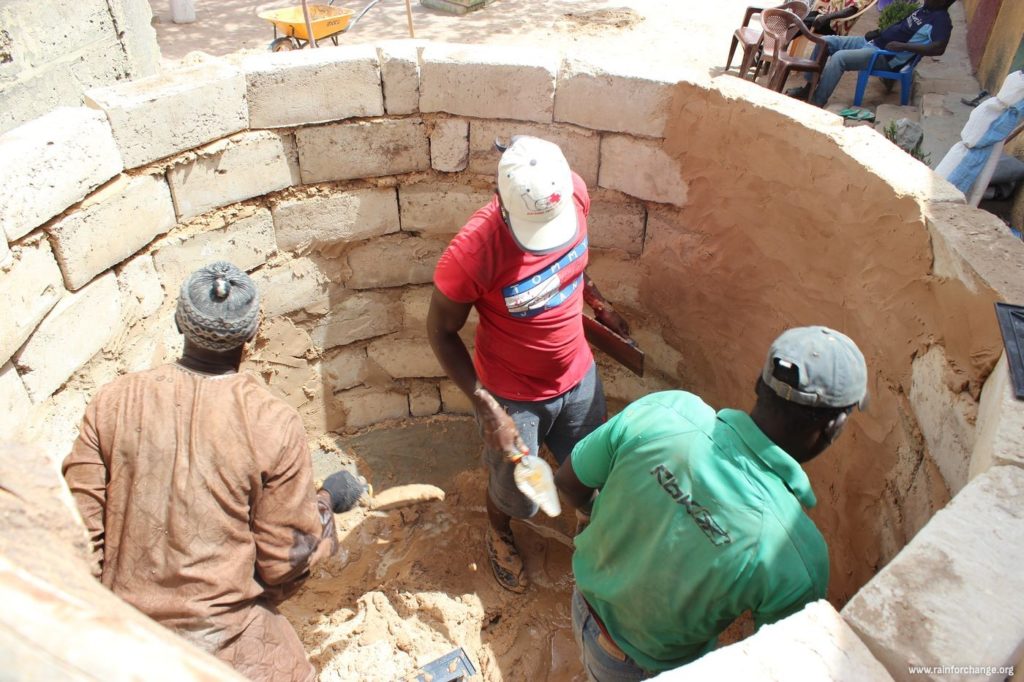
After these preparations, we went into the field to meet the builders selected to construct the calabash tanks, the rainwater reservoirs that will provide drinking water for the families of the 35 farmers supported this year. Six men began our calabash training programme. Their commitment matters, as they will carry out a key part of the project’s rainwater harvesting component. Taking part in a two-week workshop to become certified calabash builders was an important first step in our working relationship.
Once the materials and tools had been bought (sand, cement, iron bars and mesh), the Senegalese builders were trained by the experienced builders who had travelled from Guinea-Bissau. Paul Akkerman’s team shared their expert knowledge: how to measure the right ratio of sand, cement and water for a good mortar, how to apply it, and how to size the tanks. It was serious work, and the local builders were proud to learn a technique that allows them to improve living conditions in their region, but there was also plenty of friendly banter on site. Working in two teams, the qualified builders guided their trainees in a staggered approach: the two tanks built in the morning were left to dry while the teams built two more in the afternoon. This intense rhythm produced eight tanks in just two weeks, a significant step forward. With 35 tanks to build before the rains arrive in July 2019, we need both speed and skill to store all this rainwater.
As I oversee the completion of the calabash tanks and start field measurements of rainfall and soil quality, I am living with a local family. Sharing the meals and good humour of a Serer family is a real joy. I mostly speak French, my mother tongue, which all local children learn at school, but I am also picking up the basics of the local language, to the surprise of my generous hosts. They laugh when they hear me, and I enjoy slipping new words into my conversations. My time preparing this mission in IRHA’s Geneva office was desk-bound and bookish, and it made me impatient to get active on the ground. My first days in Senegal were, of course, a culture shock: M’Bour and my lakeside home town of Versoix are worlds apart. But I have found my place in village life in the Fatick-Thiès region, and so has the slackline I brought with me.
With 800 mm of rain expected over the next three months, I am impatiently waiting for the rains. These communities are rich in generosity, but for now they live in a harsh, dry environment. Once our new calabash tanks are full of clean drinking water and the countryside turns green as it soaks up the rain, I will be happier.
Bo Diaf Lakass! See you soon!
Read more on the project page: Rain, Forest and People.
First published on the former IRHA website on 1 July 2019.