
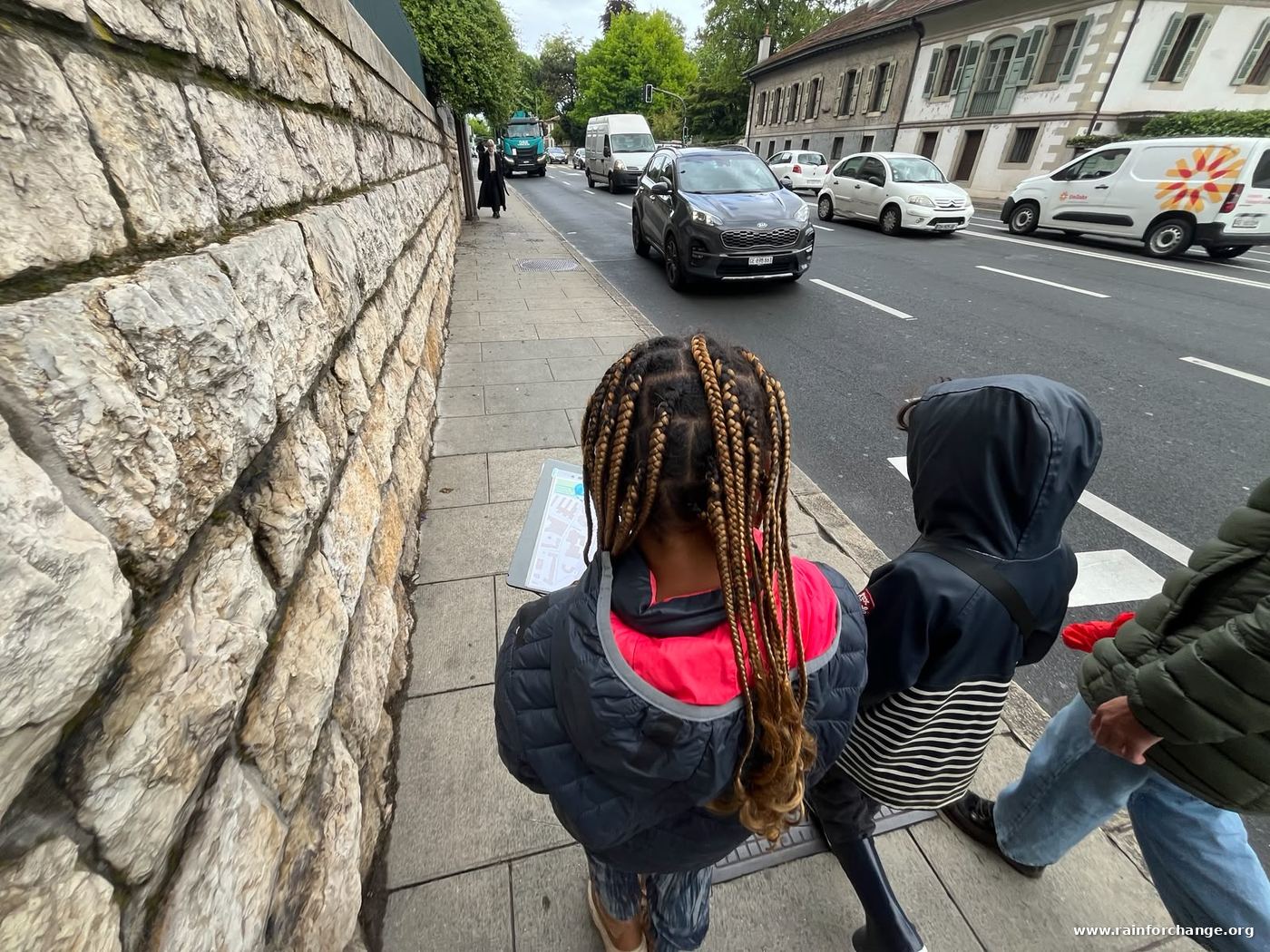
900 litres. That is roughly how much rain falls on every square metre of the canton of Geneva, Switzerland, in an average year: about 900 mm, according to the canton. A garden shed roof of four square metres receives some 3,600 litres a year. In town, much of that still disappears straight into the drains.
Source: Canton of Geneva, Eau en ville, « L’eau de pluie est une ressource, pas un déchet » (average rainfall about 900 mm a year).
On Tuesday 6 October, the lunchtime news (12h45) of RTS, Swiss public television, ran a report titled « Le canton de Genève veut mieux valoriser l’eau de pluie face aux sécheresses »: the canton of Geneva wants to make better use of rainwater in the face of droughts. The canton lists it on its Eau en ville media page. Below: what lies behind it, and practical steps for Geneva residents that make sense for rain keepers almost anywhere.
What the canton is doing
Eau en ville is run by the cantonal water office (OCEau), which also supports our Boîte à Pluie project and is a partner of PluiË. Its starting point fits in one line from the canton: rainwater is a resource, not a waste. In practice, rain is handled close to where it falls and left to soak into soil and feed trees instead of being piped away. You can already see it on the street:
- In Carouge, a town bordering the city of Geneva and one of the communes that support Boîte à Pluie, rue Joseph-Girard received the canton’s first Stockholm-type tree pit in 2021 (a planting pit filled with stones and soil that stores street runoff for the roots), built to take rain from the road and pavement and use it to water the trees (ge.ch).
- On rue des Rois, in the City of Geneva, 31 new trees were planted in Stockholm-type pits that capture rainwater to irrigate them; the works were completed in October 2023 (geneve.ch).
- In Vernier, the redesigned chemin De-Maisonneuve sends rain from its road surface into the pits of its new trees. Vernier, which also supports Boîte à Pluie, invited us to reveal rain tags at its inauguration in February 2025.
Sources: Canton of Geneva, Stockholm tree pit, rue Joseph-Girard, Carouge; City of Geneva, rue des Rois.
This summer the programme won the Trophée Thierry Maytraud 2026, in the territorial strategy category, at NOVATECH, the international conference on urban stormwater held in Lyon from 29 June to 3 July 2026.
Sources: Canton of Geneva, Eau en ville; GRAIE, NOVATECH 2026.
Why now
Europe is the world’s fastest-warming continent, and in 2025, 70 percent of its rivers had below-average annual flows, according to the European State of the Climate report by WMO and Copernicus (WMO). Geneva lives with both extremes: long dry spells and sudden, heavy downpours. Rain kept in the soil helps on both fronts, building a reserve for dry weeks and slowing water down when a storm hits.
Source: WMO and Copernicus Climate Change Service, European State of the Climate 2025.
None of this replaces drinking water from the tap. Rainwater works alongside it, for the many uses that do not need drinking-water quality.
What you can do
At home or in your garden
- Disconnect a downpipe into a barrel, a planted bed or a small rain garden. The canton says disconnecting downpipes never needs a building permit.
- Water your plants with rainwater, and leave soil open and planted wherever you can: vegetated soil soaks up rain well, bare compacted ground hardly at all.
- Before letting water soak in, check on the canton’s online map portal (SITG) that your plot is not listed as a polluted site and that the groundwater is at least one metre below the surface.
- Avoid standing water: it should not stay on the surface for more than 48 hours, and a well-designed system should not attract tiger mosquitoes.
- Mind your neighbours: water you divert must not end up on their land.
- Do not drink untreated roof water. Use it for the garden and, with a proper installation, for certain household uses.
| Small device | No building permit needed if… |
|---|---|
| Storage tank (above or below ground) | under 10 m³ |
| Rain garden or swale | excavation under 15 m³ |
| Infiltration trench | excavation under 30 m³ |
| Permeable paving | under 150 m² |
| Disconnecting a downpipe | always |
In your building, school or commune
- Ask your commune how it handles rain in its own projects: streets, school playgrounds, parks.
- Invite PluiË: rain walks, rain tags, rain dances and clay workshops can be booked by schools, associations and communes (activity catalogue, in French).
- Teachers and youth workers: Boîte à Pluie, launched in September 2026, is building a learning kit and training so you can run rain activities yourselves.
Where IRHA fits in
IRHA does not build rainwater systems in Switzerland; that is the work of the canton, the communes and their engineers. Our part in Geneva is to help people see, feel and talk about rain differently, through PluiË since 2023 and now Boîte à Pluie. We presented this approach at NOVATECH 2026 in a paper, « Boîte à PluiE, sensibiliser à la Pluie autrement ».
We also bring home what our partners in the Global South have long practised, through PartageÖ. And from 8 to 10 December 2026, the UN 2026 Water Conference in Abu Dhabi, co-hosted by the United Arab Emirates and Senegal, will put water on the world’s agenda. Rain belongs in that conversation, and the updated WHO drinking-water guidelines now give it more attention.
Source: United Nations, UN 2026 Water Conference.
In the press
More recent Swiss coverage, all listed on the canton’s Eau en ville media page:
- Tribune de Genève, « Quand la cité redevient une ville éponge », 23 June 2025
- Le Temps, « Au chevet de la ville du futur, dense et perméable », 1 August 2025
- Le Temps, « Face aux aléas du climat, les villes apprennent à retenir l’eau », 24 April 2026
- EspaceSuisse, Les cahiers 01/2026, « L’eau, nouvelle matrice du territoire »
- Pic-Vert n° 153, « Par ici la pluie ! Prendre soin de l’eau à la parcelle », June 2026
Start with one downpipe, one plant pot or one question to your commune, and tell us how it goes. Join the conversation at #RainForChange and on rainforchange.org.
Want to see rain differently with us? Our next walks and workshops are on the IRHA events calendar, and our latest news on the News & Media page.