
By Dharma Raj Dhakal (adapted by Florian Bielser)
One of IRHA’s projects takes place in the Kaski and Chitwan districts of Nepal. With three local partners – Sapana Village Social Impact (SVSI), Local Initiatives for Biodiversity, Research and Development (LI-BIRD) and Kanchan Nepal (KN) – the project aims to improve community resilience and living conditions by restoring ecosystem functions, increasing water availability, consolidating farming practices and strengthening the collective, sustainable management of natural resources by local actors.
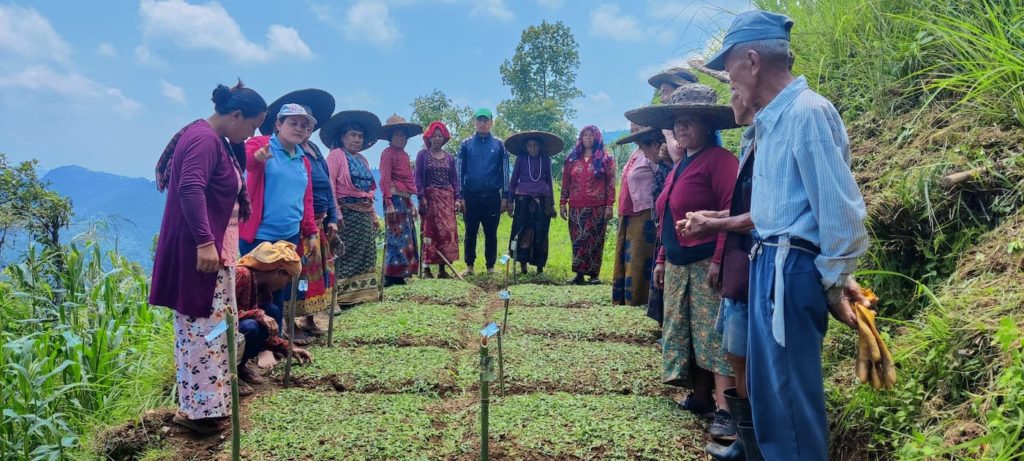
Recently, SVSI technical officer Dharma Raj Dhakal, with the help of a local trainer, ran a practical training on beekeeping and hive management in the Chepang communities around Tobang, Chitwan. The one-day training had two modules:
- Module 1: presenting the modern beehive box (with frames and a super), its parts, how to prepare it for the bees, and its uses and benefits for farmers compared with their traditional hives.
- Module 2: visiting a traditional local hive at a farmer’s house and showing participants how to transfer the colony into the modern hive, followed by practical training on beekeeping and good hive management.
Over three days, 77 enthusiastic farmers from five Rain Communities (Gurkesh, Kaule, Chhap Dada, Tobang and Hattibang) took part. The next step will be the distribution of 80 beehives, financed both by the Rain Communities project (funded mainly by the Fédération genevoise de coopération and Swisslos – Canton of Aargau) and by the local government (Ichchhakamana Rural Municipality).
Beekeeping generates extra income and also motivates neighbouring farmers to farm organically, without pesticides, since these would kill the bees. The bees will also increase pollination in the surrounding area, strengthening the resilience of local flora, spreading biodiversity and boosting the farm economy.
Read more on the project page: Rain Communities Nepal – Phase 2.
First published on the former IRHA website on 24 May 2024.