
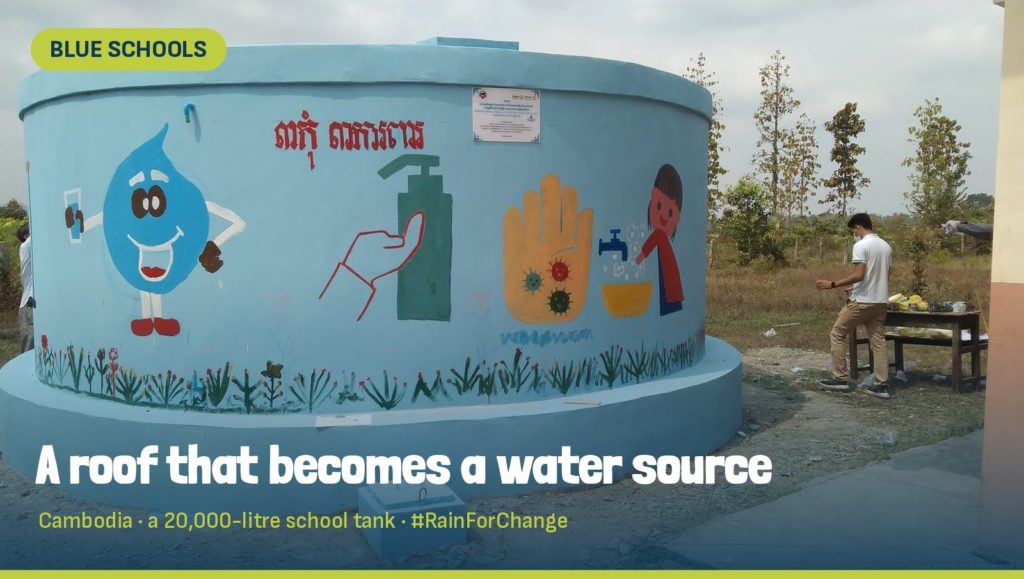
A Blue School is a school whose roof becomes its water source: the concept, initiated by IRHA in 2007, combines rainwater harvesting, hygiene and environmental education.
Hundreds of millions of children still go to schools without basic water and sanitation. According to the WHO/UNICEF Joint Monitoring Programme, in 2023 one in five children (447 million) lacked basic drinking water services at school, one in five (427 million) lacked basic sanitation, and one in three (646 million) lacked basic hygiene services (WHO, 2024). For pupils, and especially for girls, this means lost learning time, health risks and, too often, dropping out.
What is a Blue School?
The Blue School goes beyond water, sanitation and hygiene (WASH) alone: it combines rainwater harvesting, hygiene and environmental education to improve access to drinking water and support healthier learning environments. The idea is simple: a school has a large roof, and that roof can become a water source.
The building blocks
- Rainwater from the roof: gutters, a first-flush device and a storage tank collect rain from the school buildings, for drinking, handwashing, toilets and the garden. In a 2024 IRHA webinar, programme manager Florian Bielser explained that such systems can provide 2.5 litres of drinking water per pupil per day.
- Toilets and handwashing: separate toilets and handwashing stations, so that hygiene becomes a daily habit.
- A school garden: pupils practise soil and water management through vegetable growing, composting and other environmental practices.
- Trees: reforestation in and around the school, for example through the “A child, a tree” initiative in Nepal.
- Learning that lasts: playful awareness on water, sanitation and hygiene, the water cycle and waste, and murals on topics covered in class.
- A committee: a participatory management committee of parents, authorities, staff and pupils – the PACT committee in Nepal – looks after the facilities.
Water for girls
Reliable water also supports menstrual health. Toilets that girls can use in privacy, with water and soap close by, help them learn in safe and dignified conditions. The same WHO/UNICEF report found major gaps in menstrual health and hygiene in schools worldwide – a reminder of why toilets and handwashing are part of every Blue School, not an optional extra.
Where Blue Schools are today
Beyond Sri Lanka, IRHA’s Blue Schools are active in Nepal and Senegal, with new developments under way in Cambodia. In 2025, with the Lanka Rain Water Harvesting Forum and the Fédération genevoise de coopération, four schools in Kurunegala District, Sri Lanka, were equipped with rainwater systems serving 732 pupils and teachers; a management committee was set up in each school and five local masons were trained to build and repair the systems (Annual Report 2025).
Why it lasts
A Blue School is only as good as the people who run it. That is why every project includes training, a committee with real responsibilities and local craftspeople who can repair the tanks. When pupils, teachers and parents take ownership of the water, the toilets and the garden, the school becomes a hub of resilience for the whole community.
Read more on our Blue Schools page and on the Blue Schools Programme page.